
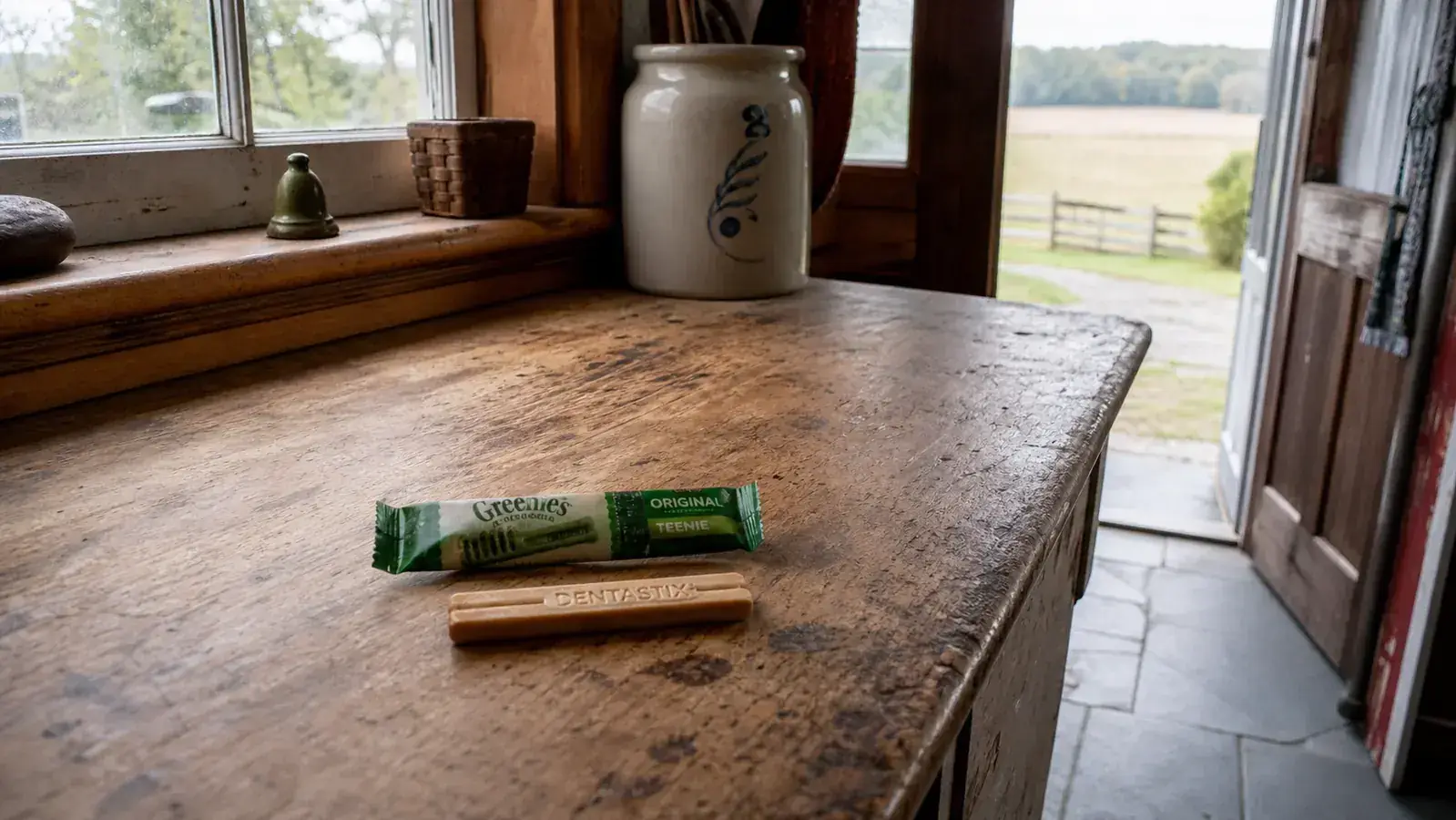
Six months ago I started giving Ruggles a Greenies chew every night after supper, mostly because his breath had gotten bad enough that Gene stopped letting him rest his head on the couch cushions during the news. That same week, my daughter Alison mentioned she'd switched her foster dogs over to Dentastix because a bag was on sale at the grocery store, and she wanted to know if she was wasting her money. So for half a year I ran both, Greenies for Ruggles and Pearl at home, Dentastix for whatever foster dog was passing through Alison's house, and compared notes every time we talked.
The short answer is that Greenies won on tartar control and on how long the improvement actually lasted, and Dentastix won on price and on how easy they were to find at a regular grocery store without planning ahead. Neither one is a replacement for a vet cleaning, and I'll say that plainly more than once in this article, because I've seen dog owners treat a daily chew like it fixes a mouth that already needs professional work. It doesn't. What it does is slow down how fast a clean mouth turns into a dirty one, and on that measure the two chews are not equal.
| Greenies | Dentastix | |
|---|---|---|
| VOHC accepted | Yes, Veterinary Oral Health Council seal | Yes, Veterinary Oral Health Council seal |
| Texture | Firm, ridged, chewy resistance that lasts | Softer, more brittle, breaks down faster |
| Visible tartar reduction (our test) | Noticeable by week 3 on both dogs | Mild improvement, harder to see by week 3 |
| Price per chew (medium dog size) | Roughly 60 to 70 cents per chew at current pricing | Roughly 35 to 45 cents per chew at current pricing |
| Grocery store availability | Common at pet stores, spotty at grocery stores | Widely stocked at regular grocery stores |
| Calories per chew (medium size) | Around 66 calories for a regular-size chew | Around 90 to 110 calories depending on size |
| Good for aggressive gulpers | Firmer, slows gulpers down some | Breaks apart faster, less resistance for a gulper |
| Ingredient transparency | Named protein sources, wheat gluten as a binder | Named protein sources, similar binder profile |
| Best for senior dogs with fewer teeth | Firmness can be tough on a worn-down bite | Softer give works better for an older mouth |
How I Actually Compared Them
This wasn't a lab test. It was two households, four dogs total across the six months once you count the fosters, and a lot of checking gums and sniffing breath at close range, which is not a job description I'd recommend to anyone who values their dignity. I looked at three things every couple of weeks: how much visible tartar had built up along the back molars, how the breath smelled first thing in the morning before either dog had eaten anything, and whether the dog was still excited about the chew or had started treating it like a chore.
Ruggles is a Lab and hound mix who eats like he's being timed, so he was the harder test for Greenies. He tends to gulp instead of chew, and I wanted to see if the texture actually slowed him down or if he'd just swallow it in three bites like he does with everything else. Pearl, my twelve-year-old Cattle Dog mix, chews more carefully because her hips are stiff and she's not in a hurry to do anything, so she was a better test of whether the chew held up over a longer, slower session.
I kept a running note on the kitchen calendar, which is a habit I've had since Alison was small and I needed to track vaccine schedules for whatever animal was living with us that year. Every Sunday I'd jot down a quick line, tartar looked better, breath still rough, chew gone in under a minute, that kind of thing. It's not scientific, but six months of consistent notes on the same two dogs told me more than a single bag of either chew ever could have.
Where Greenies Wins
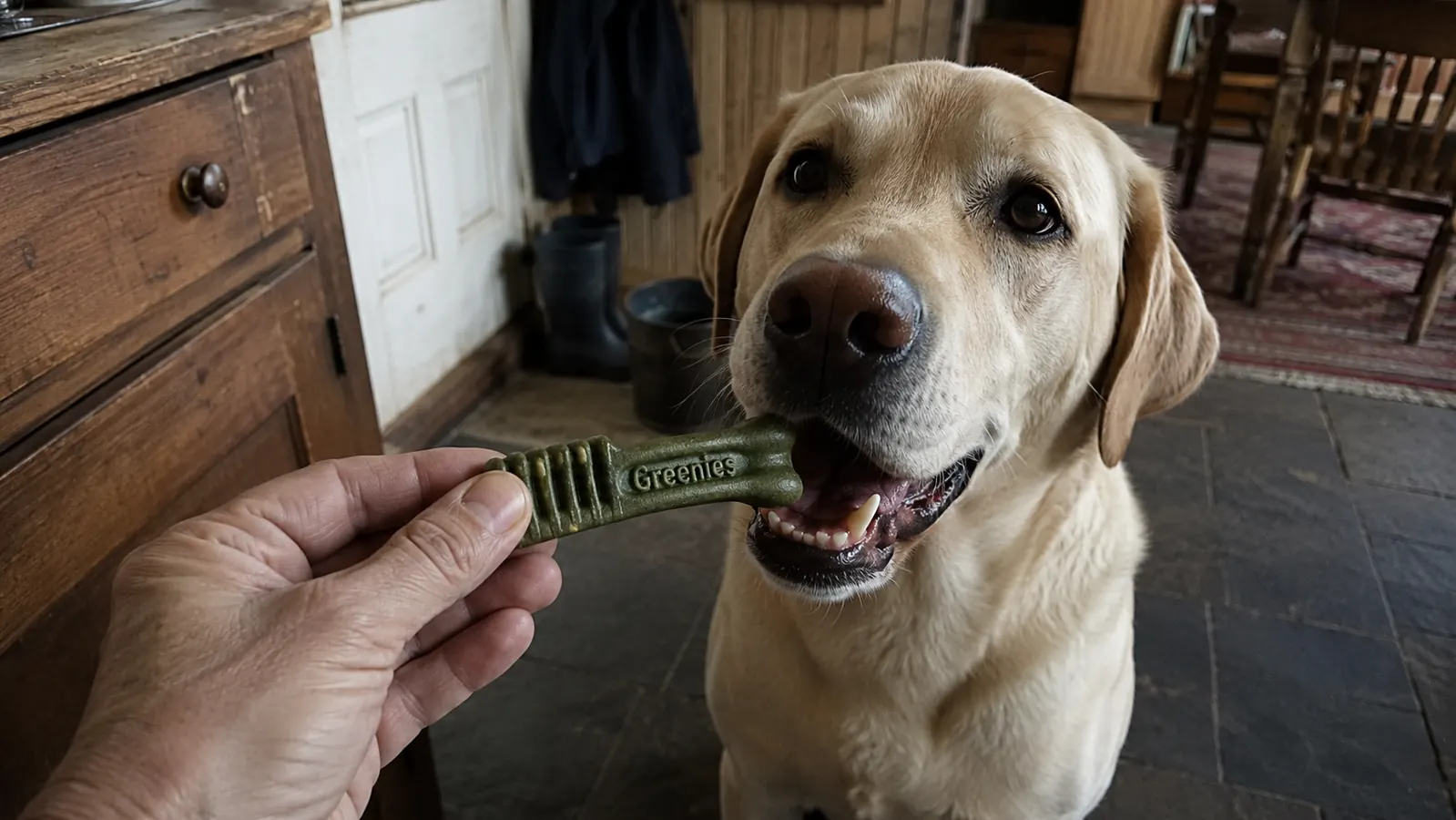
Greenies wins on staying power, plain and simple. The texture is firmer and more fibrous, and that firmness is doing actual mechanical work against the tartar as the dog chews through the ridges. By week three, both Ruggles and Pearl had visibly cleaner back molars than they'd had going into the test, and that cleanliness held up between chews instead of disappearing after a day or two. The Dentastix I watched with Alison's foster dogs never quite got there in the same window, even with daily use.
Greenies also slowed Ruggles down more than I expected. He still didn't treat it like a leisurely activity, but the ridged texture made him work for it in a way a softer chew didn't. That matters more than people think, because a dental chew that gets swallowed in four seconds isn't doing much scraping work against the teeth. If you've got a gulper in the house, and a lot of us do, Greenies held up better against that particular bad habit than Dentastix did.
Where Dentastix Wins
Dentastix wins on price and on convenience, and I don't want to undersell either of those. At current pricing, Dentastix comes in noticeably cheaper per chew than Greenies, and if you're feeding a daily chew to more than one dog, that difference adds up over a year in a way that's hard to ignore. Alison, who is currently fostering and can't always predict how many mouths she'll be feeding in a given month, needed the cheaper option and Dentastix delivered on that without a fuss.
Dentastix also wins on where you can actually buy it. I can grab a box at the regular grocery store on a normal shopping trip, no special order, no pet store detour on the way home from work. Greenies is easier to find at a dedicated pet store or ordered online, and while that's not a huge inconvenience for most of us, it's a real point in Dentastix's favor if you're the kind of household that runs out of everything at the worst possible moment, which describes mine more often than I'd like to admit.
If tartar control is the actual problem you're trying to solve, this is the one that held up
Greenies was the clear winner on visible tartar reduction and how long that improvement lasted between chews. Check today's price and pick the size that matches your dog's weight.
Amazon Check Today's Price on Amazon →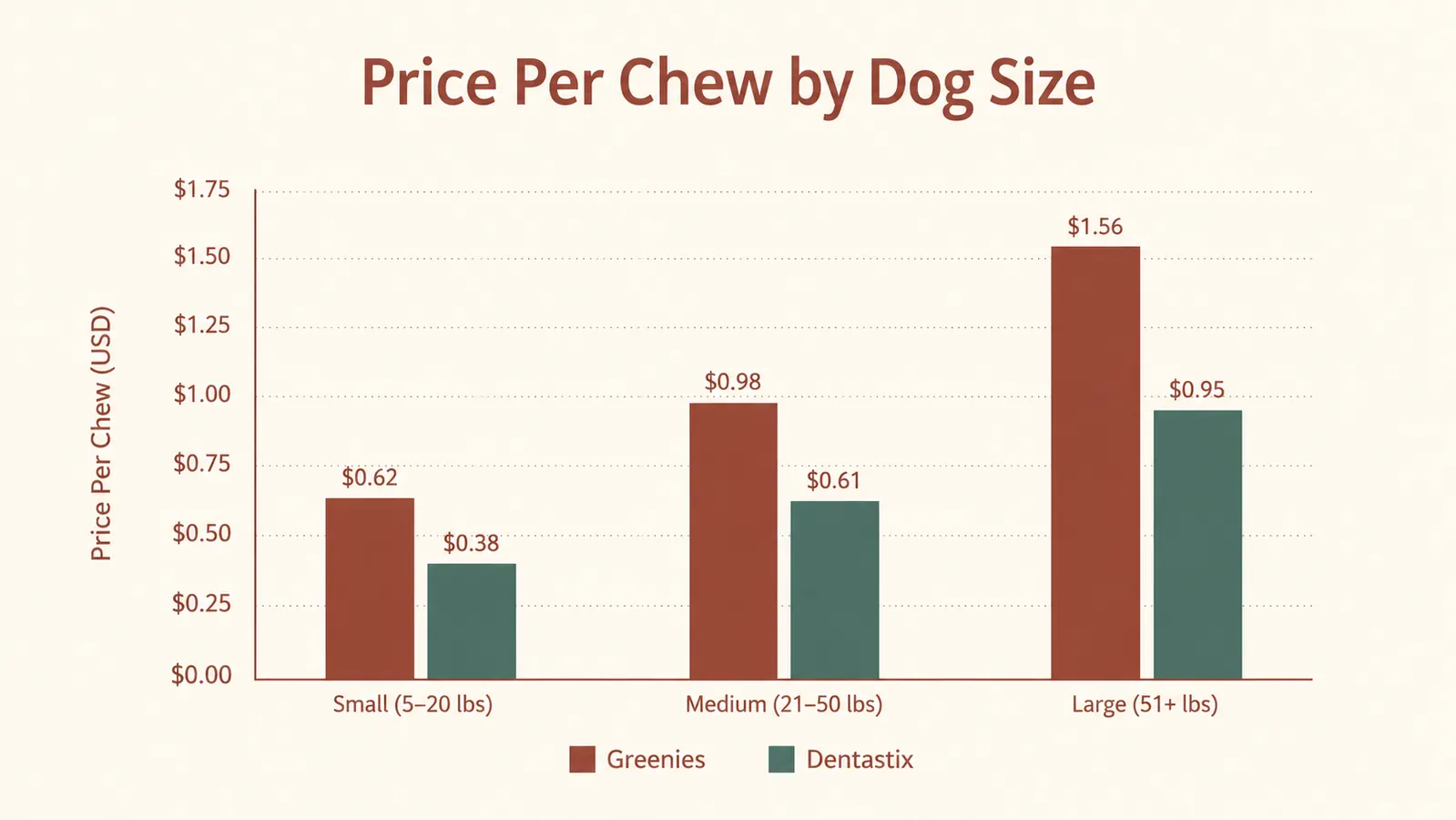
Texture and How Each Dog Chews
This is the piece that surprised me most. Texture isn't a minor detail on a dental chew, it's basically the whole mechanism. A chew that's too soft gets bitten through in two or three chomps and swallowed before it's done any scraping work against the tartar line. Greenies has a firmer, more fibrous bite that forces even a fast eater like Ruggles to work through it in stages, which is exactly the kind of repeated friction that actually removes buildup along the gumline.
Dentastix has a softer, more brittle structure that breaks into smaller pieces faster. For an older dog with worn-down teeth, or a small dog with a delicate jaw, that softness is an advantage, not a flaw. Pearl's hips make her deliberate about everything she does, including chewing, so she didn't need the extra firmness to get a slow session out of a Greenies chew. But if I had a dog with dental sensitivity or a very small breed, I'd think harder about whether the firmer texture was doing more harm than good.
Ingredients and Calorie Load
Both chews list a named protein source and use wheat gluten as a binding agent, so neither one is going to shock you on the ingredient panel if you've read either bag before. Where they differ more is calorie count. A regular Greenies chew runs around 66 calories, while a similarly sized Dentastix runs closer to 90 to 110 calories depending on the size you buy. That gap matters if you're feeding a daily chew to a dog who already needs to watch weight, which describes Pearl at twelve years old with hips that don't love carrying extra pounds.
I ended up subtracting the chew's calories from Pearl's dinner portion either way, because a daily treat has to come from somewhere in the math if you don't want a dog quietly gaining weight over six months. Greenies made that adjustment smaller and easier to live with. If you're not already tracking daily calories for your dog, a dental chew is a good reason to start, regardless of which brand you land on.

Price Per Day, Not Per Bag
The bag price on the shelf is close enough between the two that it doesn't tell you much. What actually matters is price per chew per day, since that's the real ongoing cost of a habit you're going to keep for years if it works. At current pricing, Greenies runs at the higher end per chew for a medium dog, while Dentastix runs noticeably lower. Over a year, feeding two dogs, that's a real enough gap that I don't blame anyone for choosing based on it.
But I'd rather pay more per chew for something that's actually doing the scraping work than pay less for something that mostly just gives the dog a nightly activity without much dental benefit behind it. That's the tradeoff in one sentence. Dentastix is cheaper. Greenies did more visible work on the teeth in the same six-month window. Which one matters more to you probably depends on your budget and how bad the tartar problem already is.
A dental chew that gets swallowed in four seconds isn't doing much scraping work against the teeth, no matter what the bag promises.
What This Means for a Multi-Dog Household
If you're only feeding one dog, the price gap between Greenies and Dentastix is small enough to not really change your decision. It's a couple dollars a month, and most households can absorb that without noticing. But Alison is regularly running two or three foster dogs alongside her own, and that math changes fast. A cheaper chew that still carries the VOHC seal and does a reasonable job is a legitimate choice for someone in her position, even if it's not the chew I'd default to for Ruggles and Pearl at home.
What I told Alison, and what I'll tell you here, is to think about the actual mouth in front of you before picking a side. A foster dog passing through for a few weeks with reasonably healthy teeth doesn't need the top-tier chew. A resident dog with a known tartar problem, the kind that makes the vet raise an eyebrow at the last cleaning, is worth the extra cost of Greenies. Matching the product to the actual problem beats picking a brand out of habit every time.
Who Should Buy Which
If your dog has visible tartar buildup, bad enough breath that it's a running joke in the house, or you're trying to stretch the time between vet cleanings, I'd reach for Greenies first. It costs more per chew, but the firmer texture and longer-lasting tartar control were the difference I could actually see and smell over six months with two very different dogs. If your dog's mouth is in decent shape already and you mostly want a daily habit that's easy to find and easy on the wallet, especially across multiple dogs the way Alison manages with her fosters, Dentastix is a reasonable, honest choice and I wouldn't talk anyone out of it. Just don't expect either one to replace an actual vet cleaning when the tartar has already gotten out of hand, because neither chew is built to undo years of neglect in a few weeks of nightly use. For more on how the routine actually plays out day to day, I wrote up the full six months in this longer Greenies review, and if you want the broader case for why a daily chew matters at all, this rundown covers ten reasons it's worth the habit.
Ready to see if six months changes your own dog's breath test
Greenies was the clear winner on tartar control in our head-to-head. See current pricing and sizes before you decide.
Amazon Check Today's Price on Amazon →