
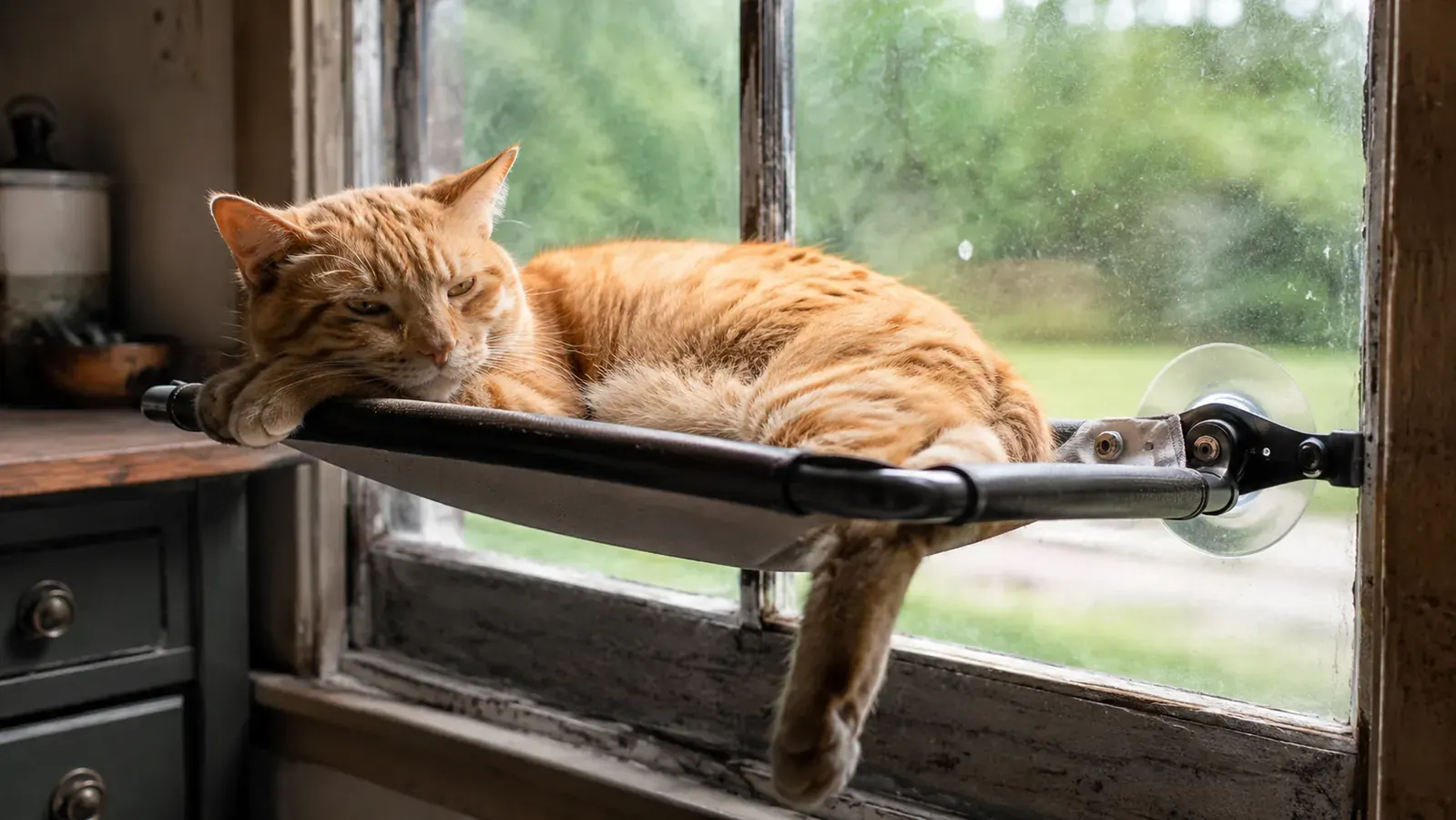
I want to get the complaints out of the way first, because most reviews bury them at the bottom after three paragraphs of gushing. The Kitty Sill has been mounted somewhere in this house for a full year now, and in that year it has fallen off a window exactly twice, both times on the same pane, both times for reasons that were entirely predictable once I understood how the mounting hardware actually works.
This isn't a takedown. Tuck, my orange tabby, still uses his Kitty Sill every single day, usually before the coffee maker finishes. But if you're about to spend real money on this thing, you deserve the version of this review that talks about suction cups letting go in January, a weight limit that is not just a suggestion, and a cushioned cover that turns into a hair magnet by week three. That's what this one is.
I've had twelve months to figure out where this perch is genuinely excellent and where it needs a specific kind of window to work at all. Most of what I'll cover below came from moving the same Kitty Sill between three windows in this old farmhouse over the course of that year, not from a week-long test period and a rush to publish.
The Quick Verdict
Solid hardware and a genuinely comfortable perch, but the suction mount is only as good as your glass, and a heavy or clumsy cat changes the math.
Amazon Check Today's Price →See the current price and glass compatibility notes on Amazon
Amazon lists the weight rating and mounting requirements right on the product page. Worth a look before you measure your window.
Amazon Check Today's Price on Amazon →How I've Used It
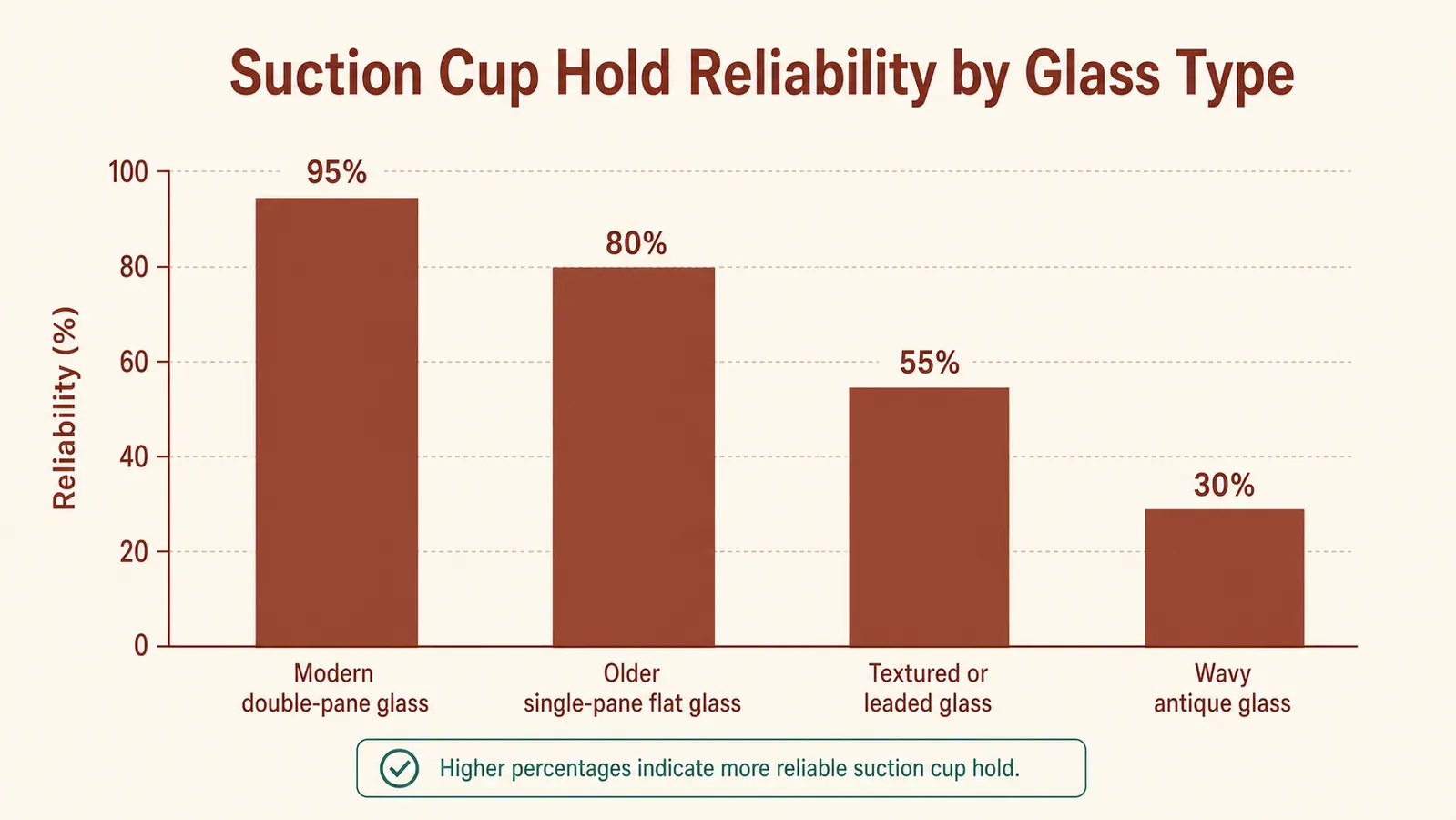
This farmhouse has old windows. Some panes were replaced at some point by a previous owner, and some are still the original wavy glass from whenever this place was built. I didn't think about that distinction until I tried mounting the Kitty Sill in three different spots over the course of the year, which turned out to be an accidental experiment in exactly what this perch needs to work.
The first mount went on the south-facing kitchen window, the one over the sink with the bird feeder just outside. That glass is a newer replacement pane, flat and smooth, and the Kitty Sill has not budged from that spot in twelve months. Tuck picked that window within the first day, mostly because of the feeder traffic, and it's been his primary post ever since.
The second and third mounts are the part of this review that matters more, because that's where I learned the hard way what the suction cups can and can't handle. One went in the mudroom over the winter, the other went in Alison's spare room for a few weeks last spring when she borrowed it for the resident cat at one of her foster placements. Both taught me something the kitchen window never would have.
Twelve months in, I still think it was worth buying, but I no longer assume a Kitty Sill will work on any window just because there's glass and a sill. The window matters as much as the product does, and that's the part nobody warns you about at checkout. I wish I'd walked around the house first and picked the best candidate window before I ever opened the box, instead of mounting it wherever seemed convenient at the time.
Suction Cups and Cold Weather
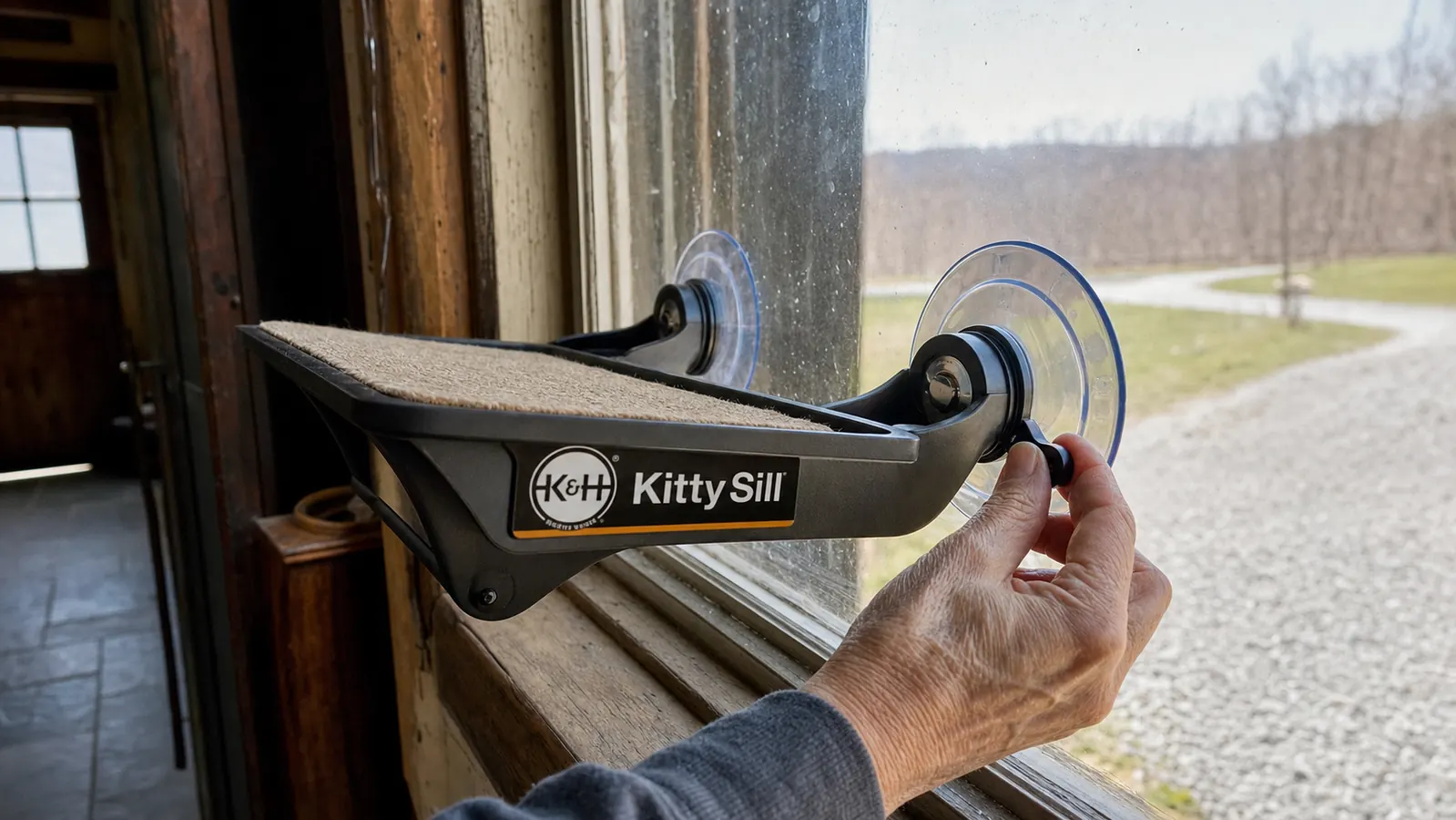
I tried the Kitty Sill on our mudroom window in late November, thinking it would give Tuck a second lookout spot facing the driveway. Within about ten days, one suction cup had let go and the whole perch had slid down and popped free overnight. Nobody was on it. It just failed on its own.
The reason turned out to be simple once I looked into it. Suction cups rely on the glass being smooth, clean, and at a stable temperature to hold a seal. That mudroom window runs cold, the glass fogs and re-clears with condensation cycles every day in winter, and that constant temperature swing works the seal loose over time in a way it doesn't on the warmer kitchen window. K&H doesn't hide this in the fine print. It's a physical limitation of suction hardware, not a defect in this particular unit.
I re-mounted it, cleaned the glass with plain water first, and pressed each cup down and locked the levers fully. It held through December, then let go again in February during a cold snap. At that point I moved it back to the kitchen window permanently and stopped fighting it. If your house has a window that runs cold, fogs, or sits in a drafty spot, that's not the window for a Kitty Sill, no matter how much you clean the glass first.
I've since talked to a couple of neighbors who bought one after seeing Tuck's, and the pattern holds. The ones who mounted it on a warm, stable interior window still have it up a year later without issue. The one who put it on a drafty porch window took it down within a month. It's a small sample, but it lines up exactly with what I saw myself, and it's enough to convince me the glass matters more than anything else in this review.
The Weight Limit Is a Real Ceiling, Not a Marketing Number
The Kitty Sill is rated to hold 40 pounds, and Tuck is a lean 14, so I never worried about weight in my own house. But the story of how he ended up claiming that window seat only tells half of what a year of ownership actually looks like, so I want to be straight about the weight limit for anyone reading this with a bigger cat in mind.
My daughter Alison fosters dogs, not cats, but she borrowed the mudroom Kitty Sill for a few weeks last spring to try it with a foster's resident cat, a 17-pound orange and white boy who genuinely believed he was a throw pillow. That cat used the perch fine sitting still, but the first time he jumped up onto it from the floor rather than stepping up from a nearby surface, one suction cup let go on impact. Forty pounds is the rating, but that number assumes a cat settling onto the perch, not one launching onto it from a standing jump with real force behind the landing.
That distinction matters more than the number on the box. A 15-pound cat that steps up gently is nowhere near the limit. A 15-pound cat that takes a running leap onto the perch is putting a much sharper, more concentrated force through those same suction cups for a split second, and that's a different physics problem than a slow static load. Nobody puts that nuance on the packaging, and I understand why, it's hard to phrase without sounding like a warning label nobody would read anyway.
If you've got a genuinely large cat, fifteen pounds and up, I'd treat the 40-pound rating as margin for the cushion and the frame itself, not as permission to assume any landing style is safe. That's just being honest about how suction hardware behaves under a sudden load versus a settled one, and it's the single question I'd ask before buying if I had a bigger cat than Tuck.
Launchers vs Step-Up Cats
Tuck steps up. He's more likely to knock a coffee mug off the counter than to leap dramatically onto anything, and I think that habit is part of why the kitchen Kitty Sill has never once come loose under him. If your cat is the kind that gets a running start and lands on furniture like it owes them money, know that going in.
There's an easy fix that isn't in the instructions but should be. Put something at the right height nearby, a chair or a low shelf, so a jumpy cat has a natural stepping point instead of a launch pad. It changes how the force hits the perch and it's saved me from a repeat of the mudroom failure since I started doing it with any cat other than Tuck who visits this house.
It's worth watching your own cat for a few days before you even order one. A cat that already uses windowsills, counters, and the backs of chairs as gentle stepping stones is going to be an easy fit. A cat that treats the top of the refrigerator as a sprint finish line is going to need that intermediate step, or you're just setting the suction cups up to fail early.
The Cover, the Hair, and the Washing Routine
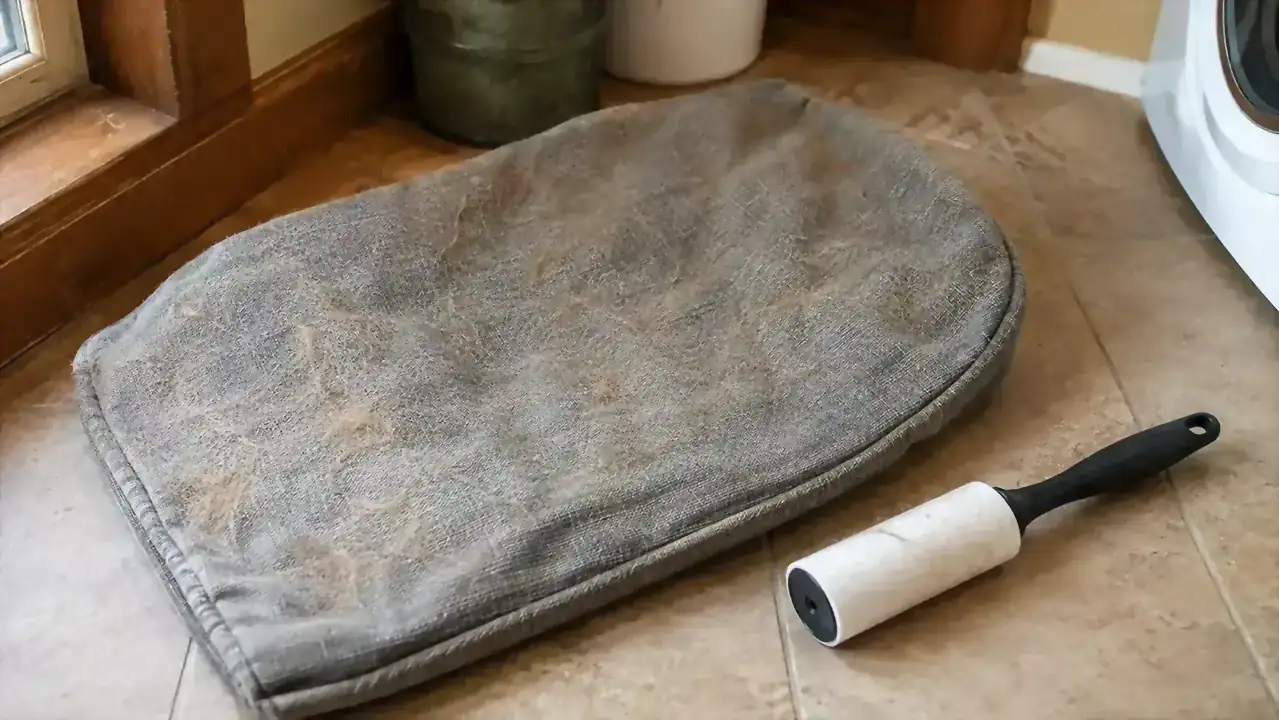
The cushioned cover on the Kitty Sill is genuinely comfortable, soft enough that Tuck will nap on it through an entire afternoon, and that's exactly the problem. An orange tabby who sheds like Tuck does turns that cover into a felted layer of hair within about three weeks if nobody's paying attention. It's washable and it comes off easily enough with the hook-and-loop straps, but it's one more thing added to the laundry rotation, and if you skip it for a month it gets genuinely unpleasant to look at.
I run it through the wash roughly every two to three weeks now, longer in shedding season if I'm honest. It holds up fine in the machine, no fraying or shrinking after a year of regular washing. The complaint isn't durability, it's that nobody mentions this is basically a small piece of upholstery you now own and have to maintain, not a wipe-down plastic shelf.
It Only Works If the Window Actually Matters to Your Cat
This sounds obvious written down, but I've seen it trip people up. The Kitty Sill on a window facing a blank side yard or a neighbor's vinyl siding gets ignored. The one over our bird feeder gets used constantly because there's something worth watching. Before you buy a Kitty Sill, look at what's actually outside the window you're planning to mount it on. Sun exposure and something moving out there, birds, the road, foot traffic, matters more to whether it gets used daily than any feature of the perch itself.
I moved the mudroom unit to the kitchen for the mounting reasons above, but even before it failed, Tuck barely used it out there. The driveway view just isn't as interesting to him as the feeder. If I'd paid closer attention to that before ever mounting it, I might have skipped the mudroom experiment altogether and saved myself the trouble of chasing a suction seal on cold glass for a spot he was never going to love anyway.
What I Liked
- Genuinely comfortable, holds a napping cat for hours
- Mounting hardware is sturdy on the right glass
- Cover is removable and machine washable
- Weight rating of 40 pounds is generous for most cats
- No drilling or permanent damage to the window frame
Where It Falls Short
- Suction cups can fail in cold, drafty, or condensation-prone windows
- A cat that launches rather than steps up can pop a cup loose
- 40 pounds assumes a settled cat, not a hard landing
- Cover collects hair fast and needs regular washing
- Does nothing if the window view is boring
The Kitty Sill isn't a bad product. It's a suction-mounted product, and suction has rules whether the box says so plainly or not.
Who This Is For
This is a good buy if you have a modern window with flat, smooth glass in a room that stays a fairly stable temperature, and a cat that either steps up calmly or has something nearby to step up from. It's also a good match if the window in question actually overlooks something worth watching, because the Kitty Sill earns its keep through daily use, not novelty. My kitchen window has proven that over a full twelve months now, and it's the one I've written more about at length because it's held up without a single issue since the day I mounted it.
It's also worth it for anyone who wants a perch they can move without patching drywall or leaving screw holes in an old frame. That flexibility is real, and it's part of why I was able to run this three-window experiment in the first place without doing any actual damage to the house.
Who Should Skip It
Skip it if your house, like ours in a couple of spots, still has original single-pane wavy antique glass, or any textured, frosted, or leaded glass. The suction cups need a flat, uniform surface to seal against, and old wavy panes have enough surface irregularity that a solid seal is difficult or impossible to get, no matter how carefully you clean and press the cups down. Skip it too if the only available window runs cold and fogs in winter, or if your cat is a committed jumper with no interest in a gentler approach and no nearby furniture to break up the landing. In any of those cases, a floor-standing cat tree near the window is going to serve you better than fighting a suction mount that was never designed for that kind of glass or that kind of landing.
Check current stock and the full weight and mounting specs on Amazon
The listing spells out the exact glass and weight guidance if you want to double check your own window before ordering.
Amazon Check Today's Price on Amazon →