
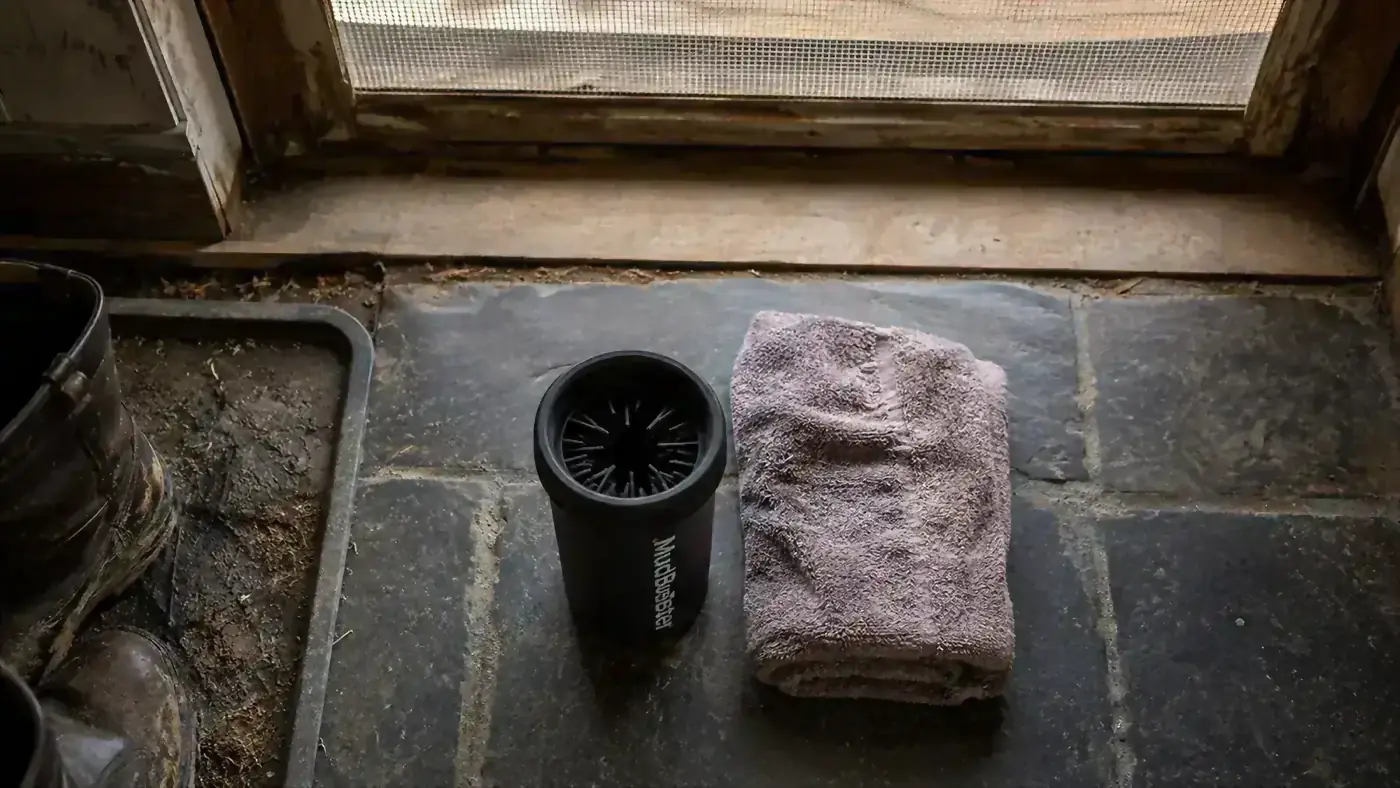
For years the routine at our place was a towel hung on the mudroom hook, grabbed on the way in whenever a dog came through the door looking like it had been dragged behind the truck. That was the whole system. Then I picked up a MudBuster last winter, mostly out of curiosity, and ran it alongside the towel through an entire mud season, roughly four months of late winter into spring, to see if a plastic cup full of water actually did anything a towel couldn't.
The short answer is that the MudBuster wins on actually getting mud out from between the pads and around the nails, which a towel mostly just smears around, while the towel still wins on speed, cost, and the fact that it works on more than just paws. Most households, mine included, end up keeping both by the door rather than picking a permanent side. But if the question is which one keeps the floor cleaner an hour after the dog comes in, that one has a clear answer, and it isn't the towel.
| MudBuster | Towel Drying | |
|---|---|---|
| Upfront cost | One-time purchase, roughly $15 to $20 at today's price | Whatever towels are already in the closet, nothing to buy |
| Setup before use | Fill with clean water and set it by the door before mud season starts | Grab a towel off the hook, no setup at all |
| Removes mud from between pads and around nails | Bristles work packed mud loose from between the toes and nail beds | Wipes surface mud but tends to push the rest deeper into the fur |
| Works on the whole dog, not just paws | Paws only, does nothing for a muddy belly, legs, or tail | Can wipe belly, legs, and tail in the same pass |
| Actually dries the coat afterward | Leaves paws damp, tracks a little water for a minute or two | Leaves the coat noticeably drier right away |
| Mess left behind after use | A cup of muddy water to dump and rinse out | No water to dump, just a dirty towel for the wash pile |
| How clean the floor stays over the next hour | Slate stayed noticeably cleaner, mud residue didn't reappear | Faint brown residue often showed back up on the slate within the hour |
| Best for standing water or deep, sucking mud | Bristles handle packed, deep mud better than a wipe can | Struggles to fully clear paws after real standing mud |
Where the MudBuster Wins
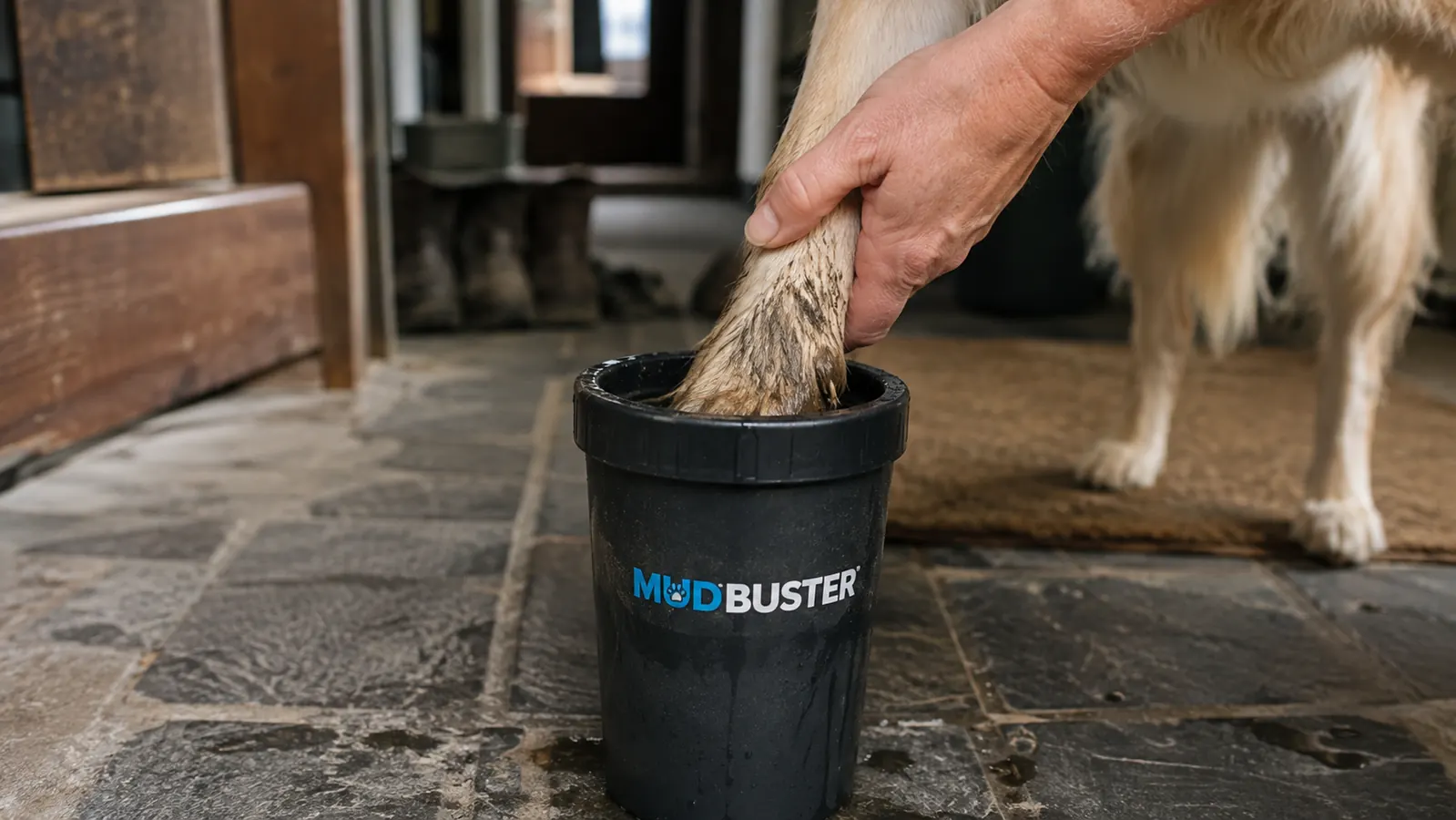
The MudBuster wins on the thing that actually matters most to me, which is what's left on the paw after you're done. A towel is a wipe, and a wipe is really just relocating the mud from the outside of the paw to whatever the towel touches next, which in our house is usually the same towel used on the next dog and eventually the same spot on the floor by the door. The MudBuster's silicone bristles get down between the pads and around the base of the nails, which is exactly where packed mud likes to hide and exactly where a towel can't reach without a lot more effort than anyone actually puts in at the door in the middle of a downpour.
Over one full mud season, roughly four months of late winter into spring, that difference showed up on the slate floor in the mudroom in a way I could see without squinting. Nights I used the MudBuster on Ruggles and Pearl, the floor stayed clean for the rest of the evening. Nights I fell back on the towel because I was in a hurry, faint tan smudges showed up near the door within the hour, usually right where a paw had brushed against the slate on the way to the kitchen. The MudBuster isn't magic, it's just doing actual mechanical scrubbing work that a folded towel physically can't replicate.
Where the Towel Wins
The towel wins on speed, cost, and flexibility, and none of those are small things in a household with two dogs and a cat who all seem to conspire to get dirty at the same time. There's nothing to buy, nothing to fill, nothing to remember to rinse out. You grab it off the hook, wipe four paws in under a minute, and move on with your evening. When I'm juggling dinner on the stove and Gene getting up for his shift, that speed matters more than a perfect paw.
The towel also does more than the MudBuster ever will, because it isn't limited to paws. Ruggles has a habit of finding the one muddy patch in the yard that's somehow bigger than the yard itself, and he doesn't stop at his feet. A towel handles his belly, his legs, and whatever ended up on his tail in the same pass, while the MudBuster sits there being very good at one job and only one job. If the mess is bigger than paws, the towel is the only tool of the two that's even in the running.
If the real problem is mud packed between the pads, the towel was never going to fix that
The MudBuster was the clear winner on actually removing mud rather than smearing it, and it kept our slate floor cleaner through a full mud season. Check today's price and pick the size that matches your dog's paws.
Amazon Check Today's Price on Amazon →Cost Over a Full Mud Season
The MudBuster is the one with an actual price tag attached, in the budget range at today's price, while the towel technically costs nothing extra since it's already hanging in the mudroom. But nothing is rarely the honest number once a full mud season gets going. Ruggles alone went through two towels a week once the mud hit its worst stretch, because a towel that's wiped four filthy paws a night doesn't stay usable for long, and eventually it needs a real wash instead of just a shake-out over the porch rail. Add Pearl's paws and whatever foster dog Alison happened to be borrowing gear for that week, and the towel pile by the washer grew fast enough that Gene started asking out loud why we owned so many old towels in the first place.
The MudBuster, by contrast, is a one-time cost that keeps doing the same job every night without adding to the laundry pile. Rinsing the cup and refilling it with clean water takes about the same ten seconds as grabbing a towel off the hook, and it never ends up in a hamper. Over four months that's the quieter cost the towel doesn't advertise on the price tag, not dollars exactly, but detergent, water, and an extra load of towel laundry a week that wasn't part of the routine before mud season started.
How I Actually Ran This Comparison
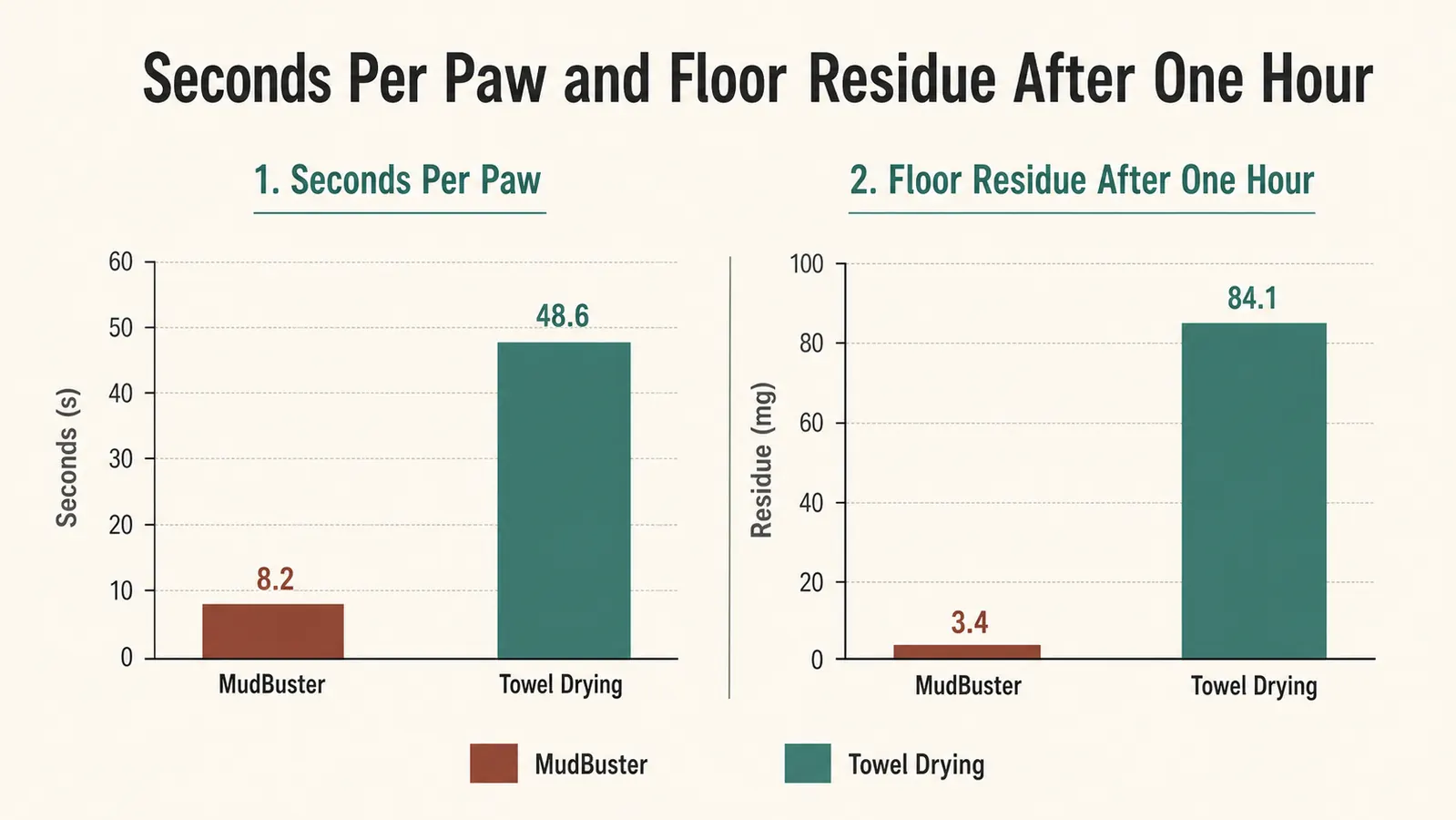
This wasn't a lab test, it was one mudroom, two dogs with very different gaits, and one long, wet season to work with. I alternated nights, MudBuster for a stretch, then back to the towel for a stretch, and kept an eye on three things every time: how long the whole process actually took, how much water or mud ended up on the floor afterward, and whether the slate near the door still looked clean an hour later once nobody had walked on it again. Ruggles, being a Lab and hound mix who treats every trip outside like a personal mission, was the harder test for either method, since he comes in worse than Pearl on a normal day.
Pearl, my twelve-year-old Cattle Dog mix, has stiff hips these days and moves slower outside, so she tracks in less but she's also less patient about having her paws handled for any length of time. That made her a good test of whether the MudBuster's dunk-and-swirl motion was quick enough to not turn into a fight at the door. It generally was, though the first couple of times took some coaxing before she settled into it as just another part of coming inside, the same way she eventually settled into it with the towel years ago.
What Actually Happens to the Floor
The floor is really the whole point of this comparison, since neither tool exists to make the dog happier, it exists so I stop mopping the mudroom every single day of a four-month mud season. What I found is that the MudBuster's advantage isn't dramatic in the first thirty seconds, both methods get a paw looking reasonably clean right away. The difference shows up later, once the dog has walked across the room a few times and whatever was left behind starts transferring to the floor on its own.
With the towel, that transfer happened more often than I expected, especially on nights when the mud was the thick, packed kind rather than a light surface coating. A towel wipe looks clean, but if there's still mud wedged between the pads, it works its way out over the next hour of normal walking around the house, and that's exactly what showed up as faint brown smudges near the door on towel nights. The MudBuster got into those gaps in a way the towel just structurally can't, and the floor reflected that difference by staying cleaner longer, night after night through the whole season.
A towel wipe looks clean, but if there's still mud wedged between the pads, it works its way out over the next hour whether you noticed it happen or not.
The Case for Using Both
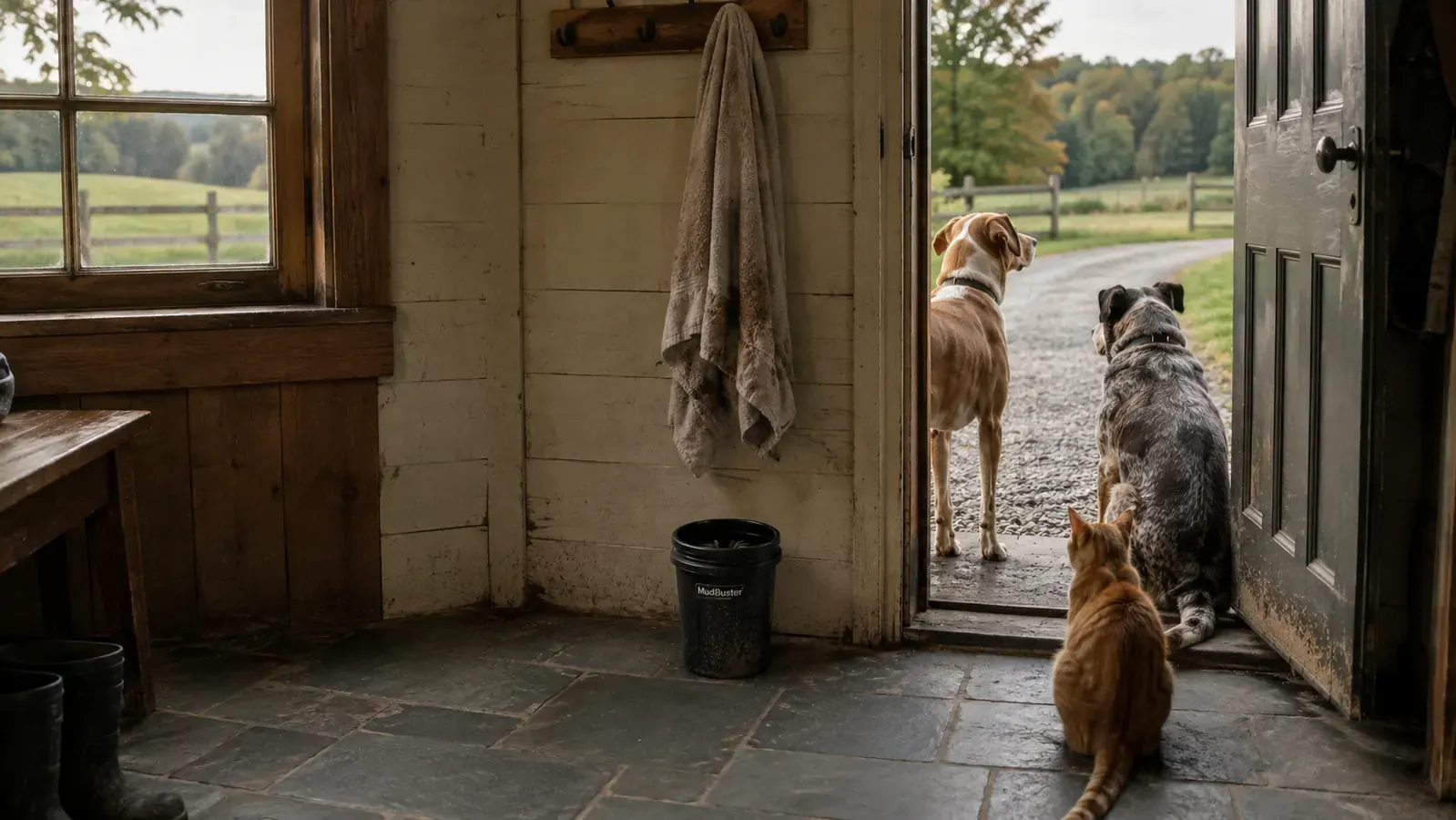
By the end of the mud season I wasn't using one tool instead of the other, I was using both, and that's probably the most honest conclusion I can offer here. The MudBuster handles the paws, especially on the days the yard has turned into something closer to a bog than a lawn. The towel handles everything the MudBuster can't reach, the belly, the legs, the tail, and it dries what the MudBuster leaves damp. Keeping the towel hanging directly above where the MudBuster sits by the door turned out to be the actual system that worked, not a choice between the two.
My daughter Alison, who fosters dogs and cycles through more muddy paws in a season than anyone else I know, ended up landing in the same place after I told her what I'd found. She keeps a towel for the quick, light-mud days when a foster dog barely got their feet wet, and pulls out her own MudBuster on the days when a dog comes back looking like it went swimming in a ditch. Neither tool replaced the other for her either, they just split the job based on how bad the mud actually was that day.
Who Should Buy Which
If you're dealing with real mud, the packed, sucking kind that shows up in late winter and doesn't let up until the ground dries out in spring, the MudBuster earns its spot by the door. It's the only one of the two that gets down into the pads and around the nails where the worst of it hides, and over a full mud season that difference is the reason our slate floor stopped looking like a hiking trail by 6pm every night. If your yard is mostly just damp rather than truly muddy, or you need something fast that also handles a dirty belly or tail, the towel is still worth keeping on the hook, and I wouldn't tell anyone to throw it out. I wrote up the full four months of daily use, dosing included, in this longer MudBuster review, and if you want the broader case for keeping one by the door year round, this rundown covers ten reasons it's worth the habit even outside of peak mud season.
See if one mud season changes your floor the way it changed ours
The MudBuster was the clear winner on actually removing mud rather than smearing it around. Check current pricing and sizing before the next storm rolls through.
Amazon Check Today's Price on Amazon →