
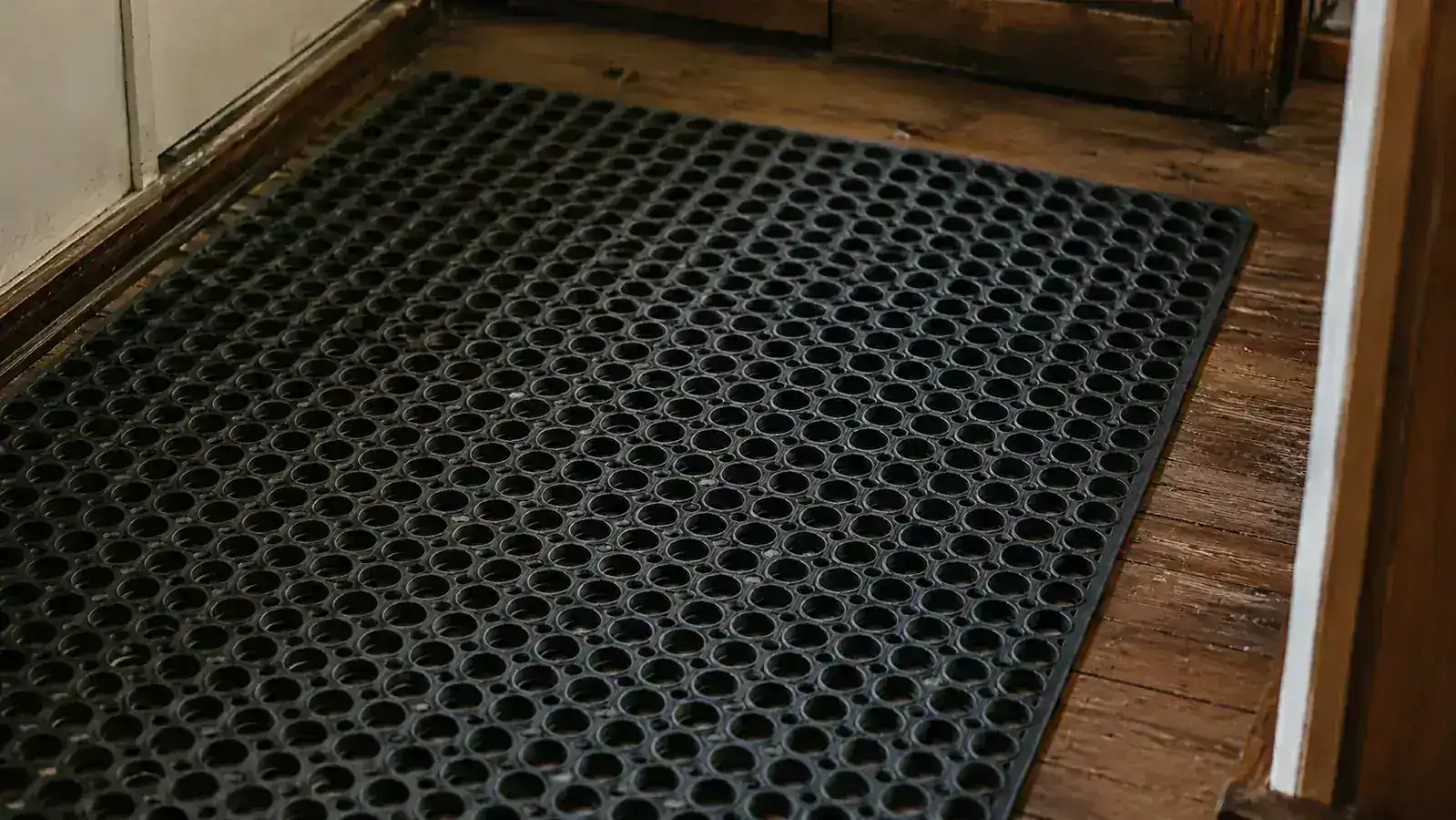
Every review of a honeycomb litter mat says some version of the same thing: it traps litter, end of story, buy it. I wanted to know if that was actually true or if it was just a good-looking design that photographed well on a store page. Twelve months ago I put the Pieviev double-layer mat down in my back hall, right against the edge of Tuck's litter box, specifically to test that claim instead of taking it on faith. Tuck is an orange tabby who scratches like he's digging to another zip code, so if a mat was going to fail anywhere in my house, it was going to fail there first.
A year later, my honest answer is neither the glowing yes the Amazon listing wants nor the flat no you'll find buried in a few one-star reviews. The Pieviev mat's honeycomb design does trap litter, genuinely, but only the litter it's actually built to catch. It has real limits I didn't understand until I'd lived with it through four full seasons, and some of those limits are the kind that would have changed whether I bought it in the first place if anyone had spelled them out plainly. That's what this review is for. Not another list of how tidy it looks in a hallway photo, but the specific mechanical things that work, the things that don't, and who should keep their money in their pocket.
The Quick Verdict
The honeycomb layer genuinely traps standard clumping litter, but it has real blind spots with fine or crystal litter, an awkward two-hand emptying process, and limited reach for bigger cats.
Amazon Check Today's Price →Wondering if the honeycomb actually does anything, or if it's just a good product photo?
I tested the Pieviev double-layer design against my own skepticism for a full twelve months. Here's exactly what held up and what didn't.
Amazon Check Today's Price on Amazon →How I Tested Whether the Honeycomb Actually Works
I didn't just put the Pieviev mat down and wait to see if the floor looked cleaner. Twice a month for the first four months, I knelt down after a full week with no shakeout and counted what was actually sitting in the honeycomb wells versus what had made it past the mat's far edge onto the kitchen threshold. That's not a lab test. It's one hallway, one cat, one brand of clumping litter to start, but it's more scrutiny than most of these mats ever get before someone writes five stars and moves on.
About two months in, my daughter Alison brought over a bag of crystal litter from one of her foster placements, where the family's own cat was using it, and I ran the same count with that litter swapped in for a week. That single swap told me more about the honeycomb design's real limits than the first two months combined, and it's a big part of why this review reads differently than the glowing version most people write.
I also asked Gene, who walks that hall barefoot most nights, to flag it any time he stepped on something after the crystal-litter week specifically, separate from his usual complaints. He did, more than once, which lined up with what I was already seeing when I checked the mat by hand.
The Honeycomb Holes Are Wider Than the Marketing Photos Suggest
With standard clumping clay litter, the medium-sized granules Tuck's box has always used, the Pieviev honeycomb top layer does what it claims. The holes are just narrow enough that a granule that size gets knocked loose from a paw and drops through to the solid layer underneath, where it stays until you deal with it. That part of the pitch is true, and it's the part every review photographs.
Crystal litter is a different story. The beads Alison brought over were small enough, and light enough, that a meaningful share of them didn't get trapped at all. They either sat balanced right on top of the honeycomb ridges where a paw could immediately kick them back out toward the hallway, or they slipped through the holes and then bounced back up through the same gaps when the top layer flexed under Tuck's weight. A one-way trap only works if the litter is sized correctly for the holes, and crystal litter, along with the finer dust that clumping litters shed over time, is often on the wrong side of that line.
So the honest version of the pitch isn't "it traps litter." It's "it traps litter of a certain size and weight," which happens to be most standard clumping clay, but is not a universal claim. Anyone running crystal litter, tofu litter, or a very fine dust-style product should expect noticeably less benefit from the Pieviev mat's design than someone running ordinary clay clumping litter like mine. If you want the fuller twelve-month diary version of this same mat, with less mechanical scrutiny and more of the day-to-day routine, I wrote that up separately at Pieviev Litter Mat Review: A Year of Tracked Litter, Tested.
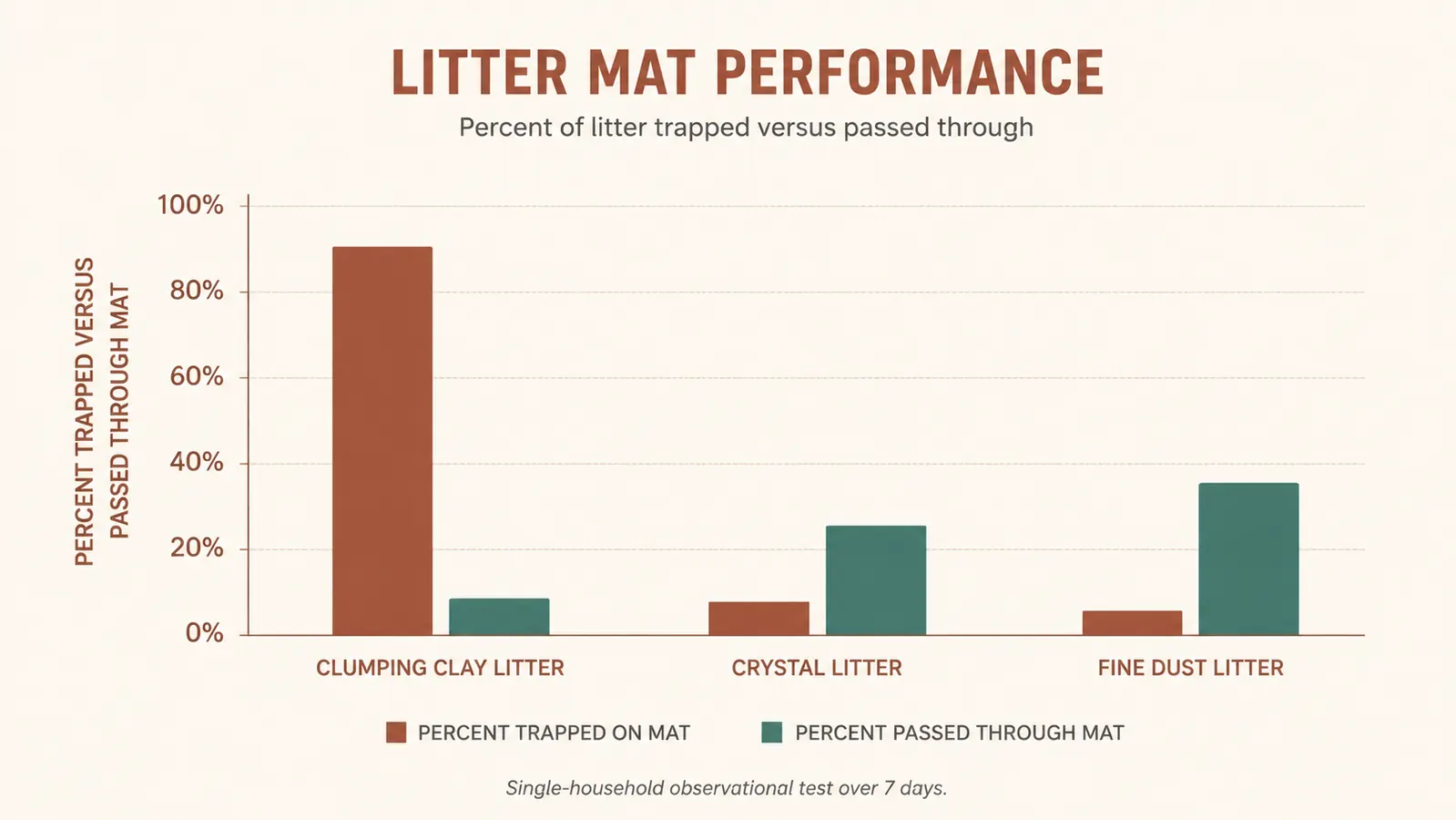
For what it's worth, the difference wasn't subtle. During the clumping clay week, checking the mat every few days, I was consistently finding what looked like eighty to ninety percent of the loose granules trapped in the wells. During the crystal litter week, using that same rough counting method, that number dropped to something closer to a third. I'm not running a lab and I don't want to dress that up as more precise than it is, but the gap was big enough that anyone shopping this mat specifically because they use crystal litter should lower their expectations before they buy, not after.
Emptying It Is a Two-Hand, Lean-Over-the-Trash-Can Job
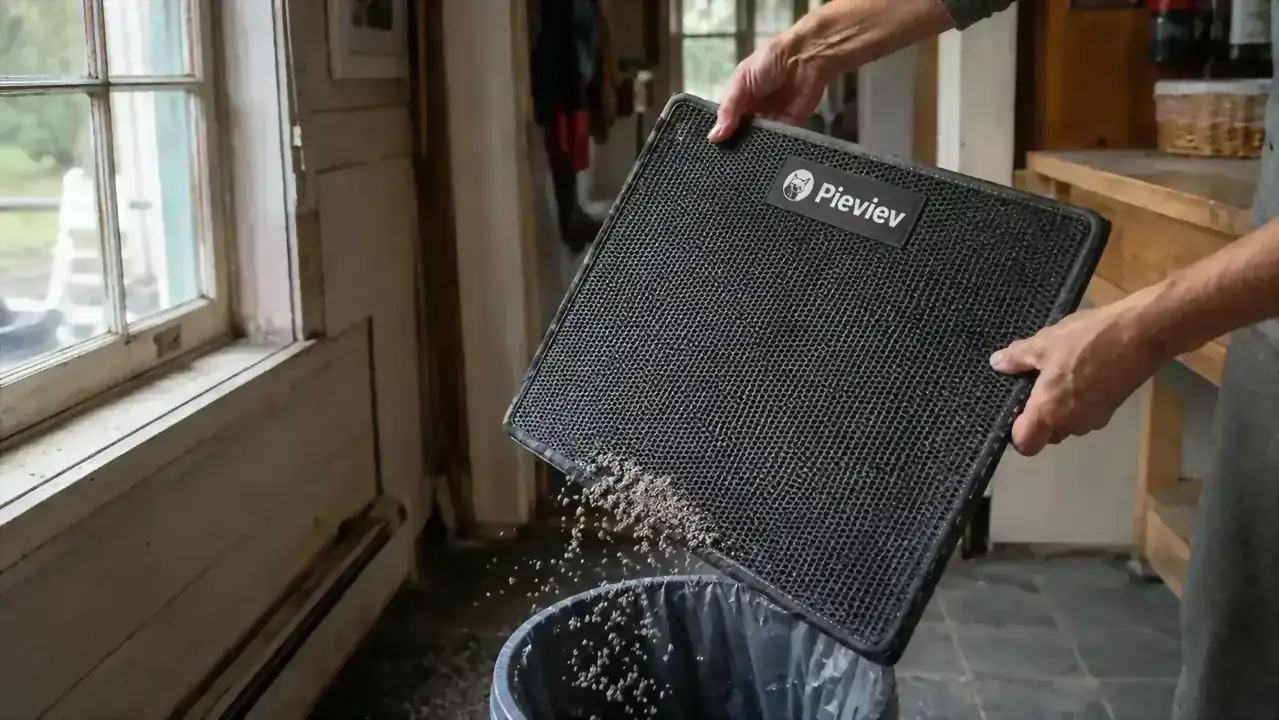
Nobody selling this mat shows you the actual mechanics of emptying it for a real deep clean, as opposed to a quick corner tip back into the box. When I want to fully clear it out and give the bottom layer a wipe, I lift the whole mat with both hands, one gripping each short end, and walk it over to the kitchen trash can to tip it. That's the part the listing photos skip. It is not a one-hand pour like tipping a dustpan.
The reason you need both hands is that the honeycomb top layer isn't fixed to the solid bottom layer. It sits loose on top, and if you only grip one end, the top layer can slide half an inch or more relative to the bottom as you tilt the whole thing. That half inch of misalignment is exactly enough for a handful of granules to miss the trash can and skitter across the floor tile instead. It's happened to me more than once over the year, always when I was in a hurry and tried to one-hand it while carrying something else.
None of this is a dealbreaker, but it's a real chore, not the effortless shake-and-done the honeycomb marketing implies. Budget two hands, a few seconds of care lining the mat up over the can, and accept that you'll be sweeping up a stray granule or two after the fuller cleanouts even when you do it carefully.
I've also tried the lighter alternative some reviewers suggest, tipping it straight back into the box instead of the trash can for a quicker, more frequent clean. That version is easier and lower risk, since the box itself is a bigger target than a trash can opening, but it only clears what's sitting loosely in the wells. It doesn't get you the full wipe-down of the bottom layer, which is the only way to catch a wet spot before it has a chance to start smelling.
The Edges Curl for Weeks, and the Timing Matters More Than You'd Think
The Pieviev mat ships rolled, and mine fought flat placement for close to a month before it finally gave up and lay down properly. That's a long enough window that it overlaps most return periods, which means plenty of buyers are forming their whole opinion of this mat while it's still actively trying to curl back into a tube. If you test it during that window and judge the honeycomb trapping performance, you're partly judging a mat that isn't sitting flush with the floor yet, which changes how well the holes actually align with a walking paw.
I weighted mine down with the litter box on one end and a stack of old phone books on the other, and by roughly the one-month mark it stopped trying to roll. If you're the type who reads reviews within the first two or three weeks of ownership and forms a permanent verdict, know that you may be reviewing an unfinished product. Give it the full month before you decide the honeycomb design isn't working the way it should.
What a Bigger Cat or a Long-Haired Cat Changes
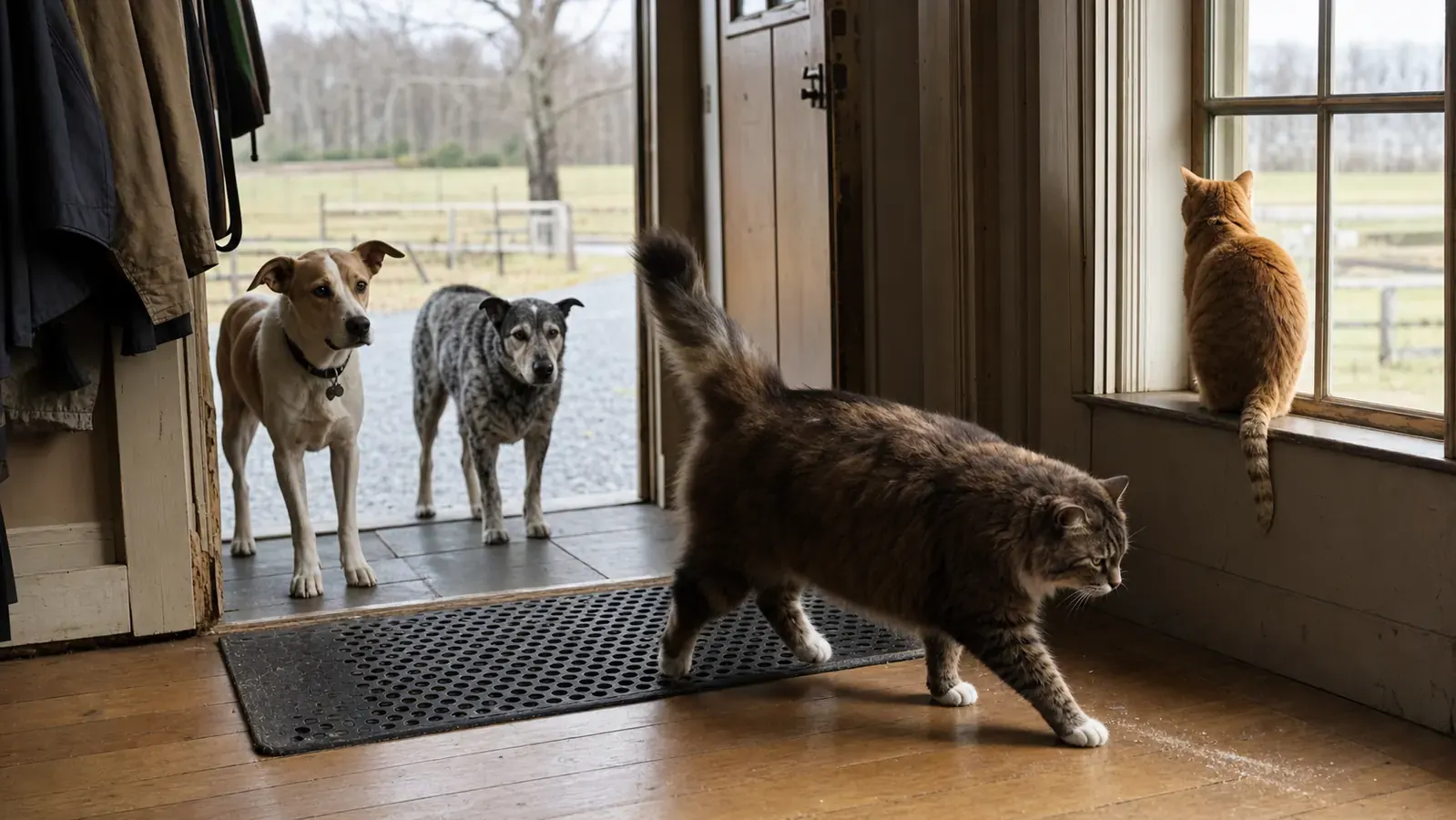
Tuck is a medium-build tabby, and the Pieviev mat's 24 by 15 inch footprint covers his exit path with room to spare. That's not going to be true for every cat. A larger breed, a Maine Coon or a big-boned mixed breed, has a longer stride off the box, and a longer stride means the first full step can land past the mat's far edge entirely, carrying whatever litter that paw picked up straight onto the floor before the honeycomb ever gets a chance to work.
Long-haired cats add a second problem that has nothing to do with paw contact at all. Litter dust and small granules cling to fur between the toes and along the lower leg, and a honeycomb mat only catches what a paw presses down into it. Fur that's carrying litter above the paw, riding along for a step or two past the mat, isn't touching the holes and isn't getting trapped by anything. I don't have a long-haired cat to test this directly, but the mechanics make it obvious why owners of fluffier breeds report less success with this exact design online.
A neighbor a few properties down runs a Maine Coon on a similar honeycomb-style mat, different brand, same basic layout, and her complaint lines up with the mechanics exactly. Litter shows up a solid step past the mat's far edge, on whichever side his back paw lands first. It's not a manufacturing flaw in either mat. It's a mat sized for an average cat being asked to do a job for one that isn't.
The Smell Question: What Happens When the Lower Layer Gets Wet
The waterproof backing on the Pieviev mat is real and it does its job for the ordinary case, a stray splash or a near-miss right at the box edge. What the listing doesn't mention is what happens if urine actually gets between the two layers and sits there before you catch it. That's happened to me twice in a year, both times because I'd let a shakeout slide longer than I should have and didn't notice a near miss right away.
EVA foam, the material both layers are made from, isn't fully sealed at the honeycomb ridges the way a solid rubber tray would be. Liquid can wick along those seams if it sits for more than a day or so, and once it does, a faint ammonia smell can linger even after a wipe-down with soap and water. The fix that's worked for me is an occasional full hose-down outside on the gravel drive, letting both layers air dry completely in the sun, rather than relying on a wipe alone. It's not something you need to do often, but pretending it never happens would be dishonest.
I've also started keeping a small flashlight near the litter box, mostly so I can actually look under the honeycomb layer at night instead of guessing whether something's pooled there. It sounds excessive for a mat this affordable, but it's a five-second habit, and it's caught a problem early twice this year that I would otherwise have only noticed by smell a day or two later.
What I Liked
- Traps standard clumping clay litter effectively, which is what most households actually use
- Waterproof backing genuinely protects the floor from an ordinary near-miss
- EVA material has held up structurally for a full year with no tearing
- Corner and end-lift emptying, once you know the technique, is faster than shaking out a woven mat
- Affordable enough that it's an easy first thing to try before spending more on a bigger mat
Where It Falls Short
- Crystal and very fine litter passes through or bounces back out instead of staying trapped
- Emptying for a real deep clean is a two-hand job and easy to spill if you rush it
- Edges curl for close to a month before lying fully flat
- Bigger-breed or long-haired cats can still track litter past the mat's 24 by 15 inch reach
- EVA can hold a faint odor if urine sits between the layers before you catch it
The honeycomb doesn't stop litter. It sorts it, and only some litter is small enough to be sorted.
Who This Is For
If you've got one or two average-size domestic cats on standard clumping clay litter, and your box sits on a hard floor where tracking has been a real problem, the Pieviev mat's honeycomb design earns its keep. It's also a reasonable pick for anyone willing to actually do the twice-monthly deep empty rather than just eyeballing it, since that's the only way the trapping mechanism keeps working instead of just filling up and doing nothing. For the fuller story of how bad the tracking was before any mat went down, and what actually changed once one did, see how a litter mat ended our tracking mess.
Who Should Skip It
Skip it if you run crystal, tofu, or a very fine dust-style litter, since the honeycomb holes aren't sized for those and a meaningful share will pass straight through or bounce back out. Skip it if you've got a large-breed or long-haired cat whose stride or fur regularly carries litter past a 24 by 15 inch footprint, since a bigger mat is probably worth the extra cost. And skip it if you're not willing to do a real two-hand emptying every couple of weeks and check for any urine that might have slipped between the layers, because letting that slide is how the odor problem starts in the first place.
Now you know exactly what the honeycomb design does and doesn't catch.
If your litter is standard clumping clay and your cat isn't oversized, the Pieviev mat is worth checking at today's price.
Amazon Check Today's Price on Amazon →