

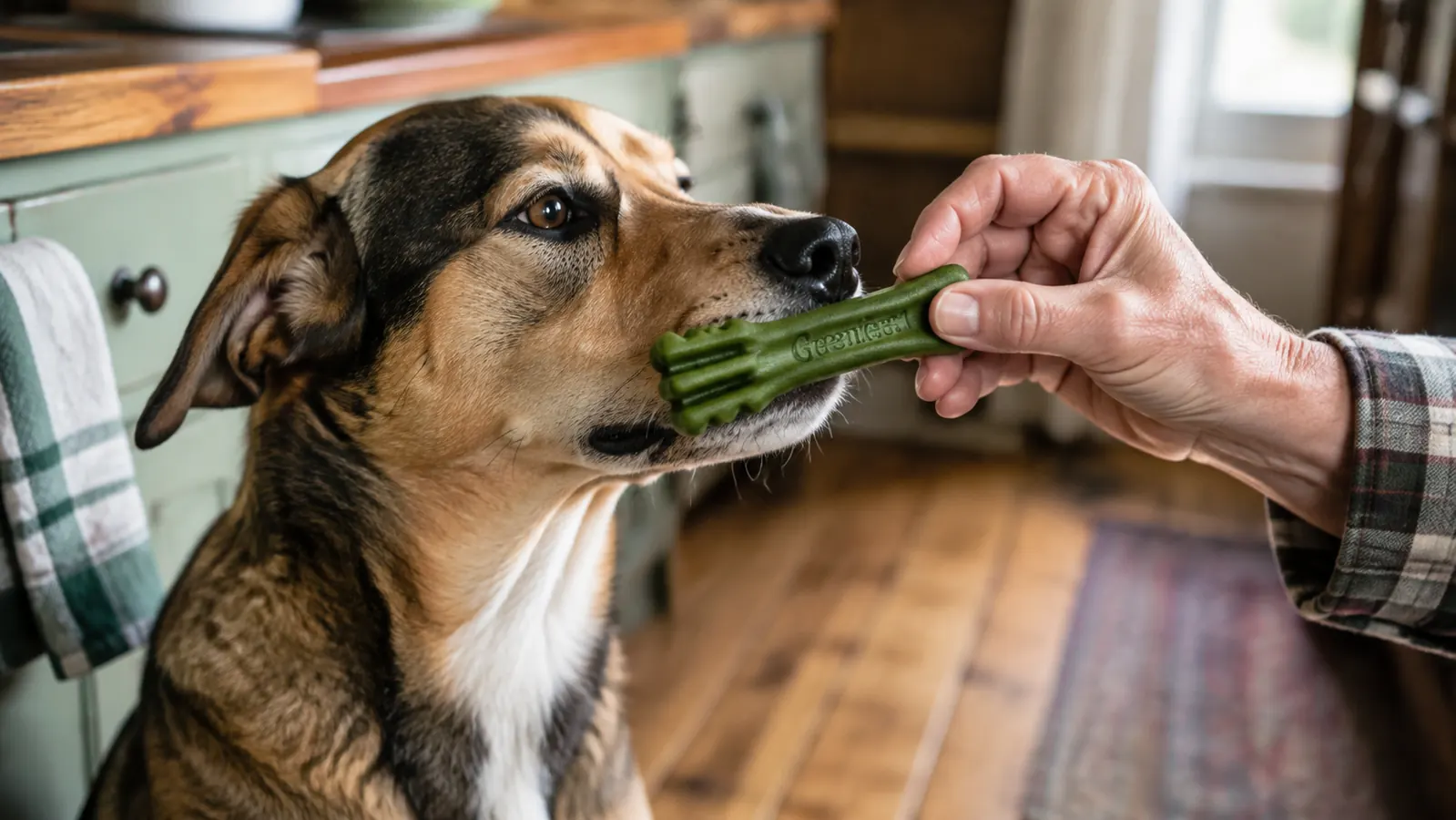
Nobody brushes a dog's teeth every single day. I know the vet's poster in the waiting room says to, and I know the poster is right, but between the farmhouse, the animals, and everything else that needs doing before dark, a toothbrush routine lasted about nine days in this house before it quietly died. What has actually stuck, going on six months now, is a lot simpler: one Greenies chew a day, handed to Ruggles and Pearl right after their evening meal, at the same time, every time.
This isn't a toothbrush replacement and I'm not going to pretend it is. It's the routine I settled on after our vet pointed out early tartar on Pearl's back molars at her senior checkup and said something like the mechanical chewing action can genuinely help between cleanings if we did it consistently. Consistently was the part I could control. So here's the actual step-by-step, sizing mistakes included, for anyone who wants a dental routine that survives past week two.
I want to be upfront about what this routine is and isn't before you commit to it. It's five steps, none of them complicated, but the sizing step and the supervision step are the two that actually determine whether it works or whether you're just handing out an expensive daily treat that does nothing for the teeth underneath it. I skipped both of those the first month with Ruggles and wasted most of a bag before I figured out why nothing was changing.
Skip the guesswork and check today's price on the size that fits your dog
Greenies come in sizes from Teenie to Jumbo based on weight, and the sizing step below matters more than anything else in this routine.
Amazon Check Today's Price on Amazon →Step 1: Weigh your dog and match the chew size, don't guess
This is where most people mess up the whole routine before it even starts. Greenies aren't one-size-fits-all, they're sized by weight range, Teenie for dogs under 15 pounds, up through Regular, Large, and Jumbo for the big dogs. Pearl is a 12-year-old Cattle Dog mix who sits around 40 pounds these days with stiff hips slowing her down, so she gets the Regular size. Ruggles, my Lab/hound mix, is built bigger and heavier at 7 years old, so he's on the Large.
The mistake I made the first month was buying one bag of Regular and just giving Ruggles two at once thinking it would even out. It didn't. A chew that's too small for a big dog gets swallowed in three bites without doing any of the scraping work against the back molars, which is the entire point. Weigh your dog, check the bag's weight range, and if your dog is sitting right on a size boundary, size up rather than down. The whole mechanism only works if the dog actually has to chew.
Worth mentioning too, dogs' weights drift, especially seniors like Pearl whose activity level has dropped as her hips got stiffer. I actually weigh both dogs every couple months now, not just when something looks off, because a dog that's crept up ten pounds since you bought the last bag might need to move up a size, and one who's lost weight from age or illness might need to move down. It's a small thing to check but it's the difference between the chew doing real work and just being background noise in their day.
Step 2: Pick one time of day and don't move it
I give the chews after the evening meal, not before, and not as a random daytime snack. There are two reasons. First, a dog that's already eaten isn't going to inhale the chew out of pure hunger, they'll actually gnaw at it. Second, consistency is the whole game with dental chews, same as brushing your own teeth works better at a set time than whenever you remember. Gene works nights, so evening feeding is when I'm home and paying attention anyway, which made it easy to bolt this onto a routine that already existed instead of inventing a new one.
If your household is chaotic in the evenings, morning works just as well. Pick whichever slot in your day is most protected from interruption, because the goal is six months of doing this without gaps, not two perfect weeks. I also keep an open bag on the counter, not buried in a cabinet, because the routine falls apart fast on the nights I have to go dig for it.
Step 3: Supervise the first few bites, every dog chews differently
Ruggles is a gulper. He's the same dog who tries to counter-surf a stick of butter if I turn my back for ten seconds, so the first week I gave him a Greenies chew I stood right there and watched. Some dogs try to swallow these things almost whole, and while they're designed to be digestible and break down, a dog that's rushing isn't getting any dental benefit and is just treating it like any other treat. If your dog does this, hold onto one end of the chew for the first minute so they have to actually gnaw against resistance instead of angling it back to swallow.
Pearl is the opposite. She's going deaf and moves slower these days, and she'll work a chew for a solid ten minutes lying by the wood stove like it's a puzzle. That's actually the ideal pace. If your dog demolishes a chew in under thirty seconds every single time, it's worth sizing up even if their weight technically fits the current size.
There's a real safety piece here too, not just a mechanical one. Any dog with a history of gulping treats or any dog eating alongside another dog who might try to steal food should be watched, at least until you know how they handle it. I feed Ruggles and Pearl their chews in separate rooms because Ruggles will absolutely try to take Pearl's if given half a chance, deaf or not, she still knows to growl at him over it.
After that first week or two of hovering, you'll know your own dog's pattern well enough to relax a little. I don't stand over either of them anymore, but I'm still in the same room, close enough to hear if a chew gets swallowed wrong or if Ruggles decides Pearl's is worth a challenge. That's the ongoing version of supervision, not full attention, just staying in earshot.
Step 4: Check the gums and teeth once a week, not just at the vet
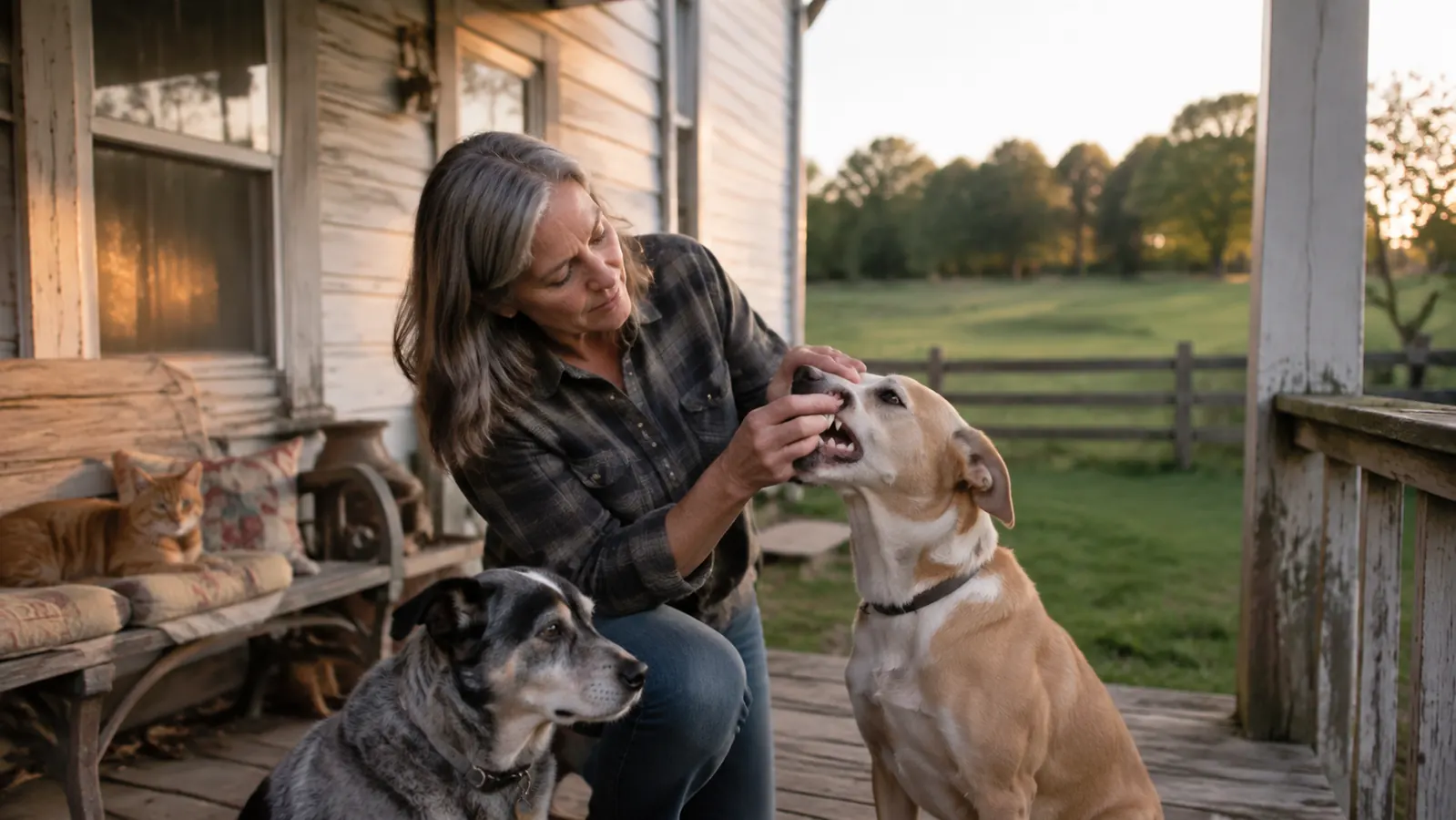
Once a week, usually Sunday when things are calm, I lift the dogs' lips and take a real look. I'm checking for redness along the gumline, any tartar buildup that looks like it's crusting rather than a light film, and whether their breath has actually improved or gone backward. This takes maybe thirty seconds per dog and it's the only way I'd actually know if the Greenies routine was working or if I was just going through the motions.
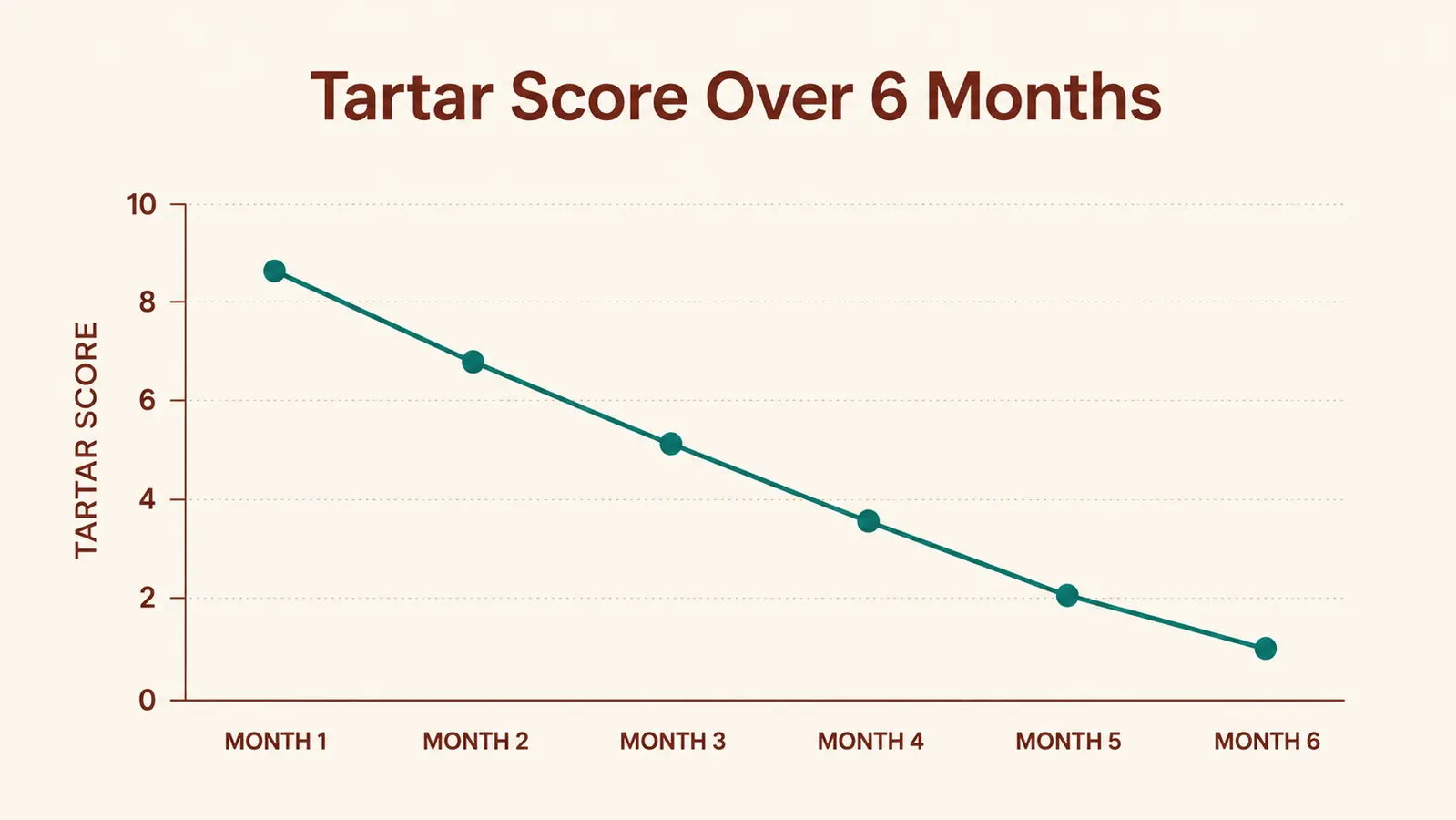
Pearl's breath was genuinely rough before we started, the kind of thing you notice when she leans in for a scratch. Somewhere around month two of daily Greenies it stopped being something I noticed at all, which for a 12-year-old dog with stiff hips who isn't going to tolerate a nightly toothbrush session is about as good an outcome as I could ask for.
I also keep a rough note on my phone, just the date and a quick word like fine or a little tartar starting on the lower left, nothing formal. Six months in, having even that loose record made it a lot easier to tell our vet exactly what had changed and when, instead of just saying it seems better, which is the kind of thing every dog owner says and no vet can really act on.
Step 5: Know when a chew isn't enough and a vet cleaning is the actual answer
This is the part I don't want to skip past. If your dog already has visible tartar buildup, that hard brownish crust along the gumline, or you can see red, swollen, or bleeding gums, a daily Greenies chew is not going to fix that on its own. Dental chews that carry the VOHC seal, which Greenies does, are shown to help reduce plaque and tartar accumulation going forward, they are not a treatment for existing periodontal disease. That requires an actual vet exam and likely a professional cleaning under anesthesia. I learned this the hard way with Pearl's early tartar spot, the chew routine is what we started AFTER her vet checkup, not instead of one.
So the honest sequence is: get your dog's teeth looked at by a vet first, especially if they're over seven or you've never had a dental check done, then use Greenies as the daily maintenance layer between whatever cleaning schedule your vet recommends. Treat it as prevention and upkeep, not a cure.
What I Liked
- Genuinely easy to stick to once it's tied to a meal
- The chewing action does visibly reduce tartar film over months, not days
- Different sizes mean it actually works for a 40-pound dog and a bigger one in the same house
- VOHC seal means there's real backing behind the plaque and tartar claims
Where It Falls Short
- Won't touch tartar that's already hardened, that needs a vet cleaning
- A dog that gulps instead of chews gets none of the benefit
- Adds calories to the day, so I trimmed a little off dinner portions to balance it
- Not a substitute for actual brushing if your vet wants that too
The chew doesn't work if the dog doesn't actually chew it. That one sentence is the whole routine.
What Else Helps
Dental chews are the easiest piece, but they work better stacked with a couple other habits. I keep a water additive in Ruggles and Pearl's bowl a few days a week, and I still attempt an actual toothbrush pass maybe once every week or two even though it's nowhere near daily. None of these need to be perfect on their own. The point of a routine like this is that it's the sum of a few imperfect habits done consistently, not one perfect habit done rarely.
I'd also say don't overthink the rest of it. A rope toy for extra chewing between meals, hard rubber chews left out in the living room, none of that replaces the daily Greenies but it all nudges the same direction. If you want to see how Greenies stacks up against the other big name in this aisle, I wrote up the comparison in Greenies vs Dentastix, and if you want the fuller case for why chews help with breath specifically, that's in 10 reasons dental chews help dog breath.
Six months in, this is still the routine that stuck. See sizes and check today's price
Match the size to your dog's actual weight, not a guess, and give the routine a real month before judging it.
Amazon Check Today's Price on Amazon →